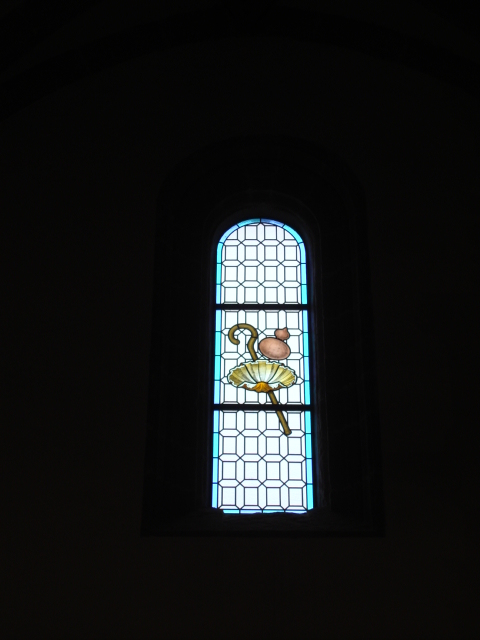
St. James

St. James
St. James above the special anniversary door of the cathedral in Santiago

Wednesday, June 9, 2010

Footfalls

Burgos to Hornillos (Tuesday, June 8th)
[Mary and Lexi and Josh are behind us by a few days. They are walking slower and are doing fewer km per day. We are keeping in touch by email. As of today (Wed. 9th) they are headed towards Belorado.]

Stella and I actually sleep in a little bit in our palace in Burgos! What a luxury, except I really didn´t sleep any better there than I do otherwise. But I still enjoyed it. And we don´t have everyone else around us, getting up early or rushing around or squeezing in to get their stuff packed. We have a leisurely breakfast with Marie Noelle of bread and jam and another wonderful French cheese and tea con leche. Grudgingly, we leave our palace.

We head out of Burgos, along the Camino. The guidebook always seems to make the path straighter than it actually is. As we cross back over the river, we make our way to the convent at Las Huelgas. We have to ask directions a couple of times, but we find it without too much problem. When we reach it, we round a corner to see a whole street that is almost like a movie set, it seems so perfect and so different from what surrounds it. It looks like a medieval village established to support this convent. The convent looks nothing like the picture that I have posted on the early blog, so I don´t know whether that´s a view that we don´t have access to or what. It is virtually a castle - a world - unto itself. Remember that this was a whole community established for noble women (presumably so they wouldn´t have to associate with common women). It was an opportunity for them to learn and to be in positions of leadership. The women created and performed an extremely sophisticated form of polyphonic music for their time. According to Michener, this was an extremely powerful convent. It was said that "if the pope ever had to take a wife, only the abbess of Las Huelgas would be eligible." Unfortunately, the convent doesn´t open until 10 am which is an hour later than when we are there and we don´t really want to wait around that long when we have 20 km waiting in front of us. I wish I could have a sample of someone performing music from here. Even just touring the outside of the convent is an interesting side trip.

We get back onto the Camino. There is some kind of tree that is sending out white fuzzy stuff that comes down and accumulates in drifts by the side of the roads and paths, almost like a very dry snow. I guess they are some sort of seeds, almost like milkweed pods.

It is a good day's walk, except that for me, my one foot is a problem between a serious blister on one toe and a nerve problem in the foot. By the end of the day, I am seriously hurting and compensating in my walk so much that I can feel it all the way up into my hamstrings and gluteous. Not a good thing. It is only about a 20 km walk, but it seems to take forever. There are 3 or 4 villages that we pass through on the way, each interesting in their own way. I stop in Tardajos midmorning at a bar/cafe for a tee con leche to take a rest. Always a good thing. I sit at a table outside as it is too smoky inside. I watch as contractors work at refurbishing a house next door. Despite the economy in Spain, I am surprised at how much construction, big and small is being done. It is everywhere. The waitresses always appreciate it when I bring the dishes in from outside. How far is it to Hornillos? Another 10 km give or take? Oh. I was hoping for a little less. Ok. I take advantage of the facilities as long as I am there and am quite pleasantly surprised to find that it is completely handicap accessible in this little, out of the way village. And, it's a really nice bathroom, which cannot be said of many of the places we stop! On the road again, just can´t wait to get on the road again...

The next town is Rabe. It has an interesting church and building connected to it, but unfortunately, the church is closed. I take a picture of the handcrafted fountain. On the way out of town, there is a neat little chapel where I have lunch out of the stuff in my sack. Then I realize it is the entrance to a cemetery! So that's what 'monasterios' means. Oh well.

We begin the meseta today. Meseta comes from the word for table, mesa. I have the idea in my head that it should be completely flat because the books talk about all you see for days on end is the horizon, the fields meeting the sky. But I still see hills. And I am still climbing. It finally occurs to me at some point that to be a table means getting to the table TOP. Why didn´t I think of that before? But even once I am sure I am on the meseta, it is not completely flat. It does seem rather like walking across Kansas or Nebraska however. The fields just go on and on. It is absolutely beautiful and serene. The fields are oats, wheat and barley, though don´t ask me where the oats are. I think I can tell the other two apart. Still, there are wild flowers all along the path. There are several kinds of lavendar and I rub my hands on it frequently, just to enjoy the smell.

The guide book talks about protecting ourselves from endless sun and the lack of shade in this part. We are lucky this day. It is cloudy, and even a few drizzly drops, so I break out my Kmart special poncho. It is highlighter pink. You can seem me coming or going for kilometers across the meseta. I feel like a large walking traffic cone. But I´m visible for walking near the road!

Eventually Hornillos comes into view. (I think the name has something to do with the word for 'little ovens.') At the end of each day´s walk, and the day´s goal appears, it is rather like Dorothy getting her first glimpse of Oz! It´s there, it´s doable, I´m going to make it! Hornillos doesn´t have too much going for it - one little alimentacion (small grocer) and one little bar/restaurant. Once we get settled, Stella and I leave the alburgue to get a few things to eat for the next days breakfast and journey. Just outside, we find a small, baby bird that is huddled against the somewhat blustery wind of the meseta.


Then we have dinner at the little restaurant. It is actually a very good little pilgrim dinner. The chicken is quite good, with a good glass of wine, and great white asparagus as a first course, and the usual little tri-flavored ice cream for dessert. Who could ask for a better ending to a good day´s walk?

Monday, June 7, 2010

Express

Belarado to Burgos (Monday, June 7th)

Today was a lovely day to walk. Stella left Belarado early than I did. At my alburgue, we were asked when we checked in to not get up before 6 am as ´pilgrims need their rest.´ I slept well from about 10 pm until 2 am, then heard the church bells every hour from 2 until 6. I don´t know whether I slept in between or not, but if so, it wasn´t much. At least I was by the only window in the room and could feel a bit of a breeze. Part of my not sleeping, I think, on some nights at least, is the fear of rolling off of the top bunk of these narrow bunk beds! It would not be hard for someone who moves a lot, when you are already wrapped up in the cocoon of a sleeping bag - one wrong move and thud, splat!

Anyway, morning came, and with very little room to move and not much light to see by (we always resist turning on the light for those who wish to stay in longer), it is difficult to do the ritual of unstuffing/stuffing the pack in just the right order. Taking care of the feet and putting on the boots has to wait until going downstairs. Most alburgues have you keep your boots in a certain area near the front door to minimize dirt throughout the place. At least I had a day without doing laundry yesterday because it was too damp for it to dry on the line, so I just pack up the few things that are dirty and will have more to do later today. A quick breakfast of bread and jam and tee con leche and I´m off.

As I walk out the door, I look up at the facade of the Iglesia de Santa Maria next door. What I hadn´t noticed yesterday was the stork highrise complex on top. There are at least four nests on the part that sticks up with the bells, with birds and fledglings in each. The penthouse is obvious as the largest and sloppiest, twigs and branches spilling down more than the others. I also hadn't really noticed the caves and dwelling built into the rocky hillside behind the church yesterday. Apparently someone actually lives there or it is used for something.

The walk this morning begins with clouds and gray skies, and nice cool temperatures. There are several small villages as we cross through farmlands. I am reminded of home in many ways. There are some things that are like south Georgia - some of the roads look like tabby except instead of oyster shells, it is simply white rock. The large rectangular bales of hay (instead of our big rolls) are tied with big orange ropes, just a bigger version of our pine straw bales. I walk through clouds of gnats and do my best south Georgia pfff through my lower extended lip. It's just about as effective (or not) as it is there. But then, there are also things that remind me of Northern Virginia and south central Pennsylvania with which I am also familiar. Just outside of Belarado, I cross the Rio Tiron, which is much prettier than Tyrone, PA ever thought about being, but the name connection is there. Later, the rolling hills are exactly like the hills I drive through near Winchester, VA and up through Frederick, MD and into Adams and York County, PA. If the buildings weren´t visible, I could think I was thousands of miles away.

The path goes through several little communities. I stop at a church in Espinosa de Camino, the town before Villafranca, to take a short break. The church is not along the Camino, but over in a corner of the village. It is not open, but there's a bench outside and no one around, so I take off my pack and just rest for about 15 minutes, and I try to do a little centering prayer for a change. Not so easy to do over here as I had hoped. It´s hard to find a place where there are not people and distractions. It is a good time in a quiet place in the sun. While I am sitting there, I know that I am affirmed in my sense of call to come on this pilgrimage and in my following through on that call. In what I tend to refer to that 'voice without a voice,' or some would say that 'still, small voice,' I know that I hear God say to me, "I have brought you here." And in my usual way (perhaps too casual, but we have a pretty down-to-earth relationship), I simply reply inside, "Yes, I know." I wait for more to come, but that is really it. Which is actually quite enough and all anyone ever really needs. But, being me, I can't resist asking, after several more minutes, "Why?" But there isn't any further response. Other than the Camino beckoning me onward. Several days from now, and I'm not sure which day, the answer will come as I'm walking. "To rest." I spontaneously laugh out loud (I'm alone) when the answer comes. "You want me to walk 500 miles so that I can REST??" But in my heart, and my body and mind, I know that's exactly what I'm here to do and what I'm actually doing. Resting in God. It is not an oxymoron to be physically active but still to be resting in God. In fact, sometimes thats exactly what the picture in Webster's Dictionary would look like.

Back on the trail, feeling refreshed not only from the break but from the affirmation, and nearing Villafranca, I pass a funny little ruin. The name painted on the trail marker says it is the Monastery of St. Felix the Goose! Honk if you love God!
A couple more kilometers and I am in Villafranca. It takes a couple of questions to find the bus stop and meet up with Stella. First, I go up the hill, where it seems likely to be, but that turns out only to be a splashy little hotel. I have no idea why it would be in this little town. As I come back down the hill, I cut through a church parking lot. There is a group of three or four little old ladies, bent over a wheelbarrow outside the church. The wheelbarrow is laden with a folded up oriental rug on the bottom and then stacked with a tall stack of white linens. The ladies have carried all the linens into the church before I suddenly realize that I am observing the Altar Guild of St. Somebody's in progress! This is how they haul everything back and forth to the church!


At last, I find the bus station and Stella and we decipher the schedule, though we don't actually trust it. We sit in the little glass booth, and fortunately for us, the bus comes sooner than the posted time. We make sure it is really going into center-city Burgos before we board. We have decided to take the bus because the next 15 km from here are through very scrubby vegetation with no facilities or towns, and it is very hilly. Then there are a few kilometers of towns, followed by another 10 km of just industry. The Brierly guidebook puts it this way in regard to the industrial section: "Steel yourself for the long hike through the industrial and residential suburbs to the cathedral and albergue in the city center along one of the busy access roads...try working with the energy of the traffic rather than fighting against it...Due to the insatiable demands of a modern economy, many of the original paths into the city have been obliterated by the bulldozer. We can usefully take this time to reflect on areas of our own lives where we have allowed these materialistic forces to bulldoze our own inner pathways out of seeming existence. Burgos is perhaps a perfect reflection of our ´developed´ world. It is easy to blame the faceless government and developer, but they only build to feed our desire for a more convenient lifestyle...Are we ready to embrace a life of voluntary simplicity, not because we have to but because we want to?" Pretty good food for thought. Neither of us feel the need to walk these 25+ kilometers (15 miles) through all of this, however. It doesn´t change the pilgrimage for us. Neither of us has a martyr complex or sees the need to walk through parts that would not be particularly soul enriching and only draining. Most of the bus trip is very close to the Camino, and as I watch it, I keep thinking, I´m so glad we made this choice...(I think the other perigrinos on the bus are thinking similar thoughts!)

So we are at an alburgue run by Jesuits and beginning to explore this lovely city. And guess what? Remember that program on Performance Today with music from Los Huelgas and I didn´t know where it was? It´s just off the Camino on the way out of Burgos, so you will get to know more about that, too!

To continue...(a couple of days later)

Well, Stella and I felt like princesses in our very own palace in Burgos, Emmaus! We were the only two peregrinos staying at the alburgue. We had a little trouble locating it because it wasn´t exactly where it was supposed to be according to the guidebook, but as always, people around us noticed the puzzled look on our faces, knew exactly what the question was and showed us where we needed to go. It turned out to be this 1800s building that had been renovated extensively (we saw the album!) into the best alburgue we have stayed in hands down. It is attached to a large Roman parish church, chapel and offices and a nice looking priest showed us where we could leave our bags until we could come back at 2 to check in. When we did come back later, Marie Noelle, the lady that runs the place, showed us around. She is a Carmelite nun - apparently they do not live in community or ever wear habits. They have vocations out in the world. Hers, in addition to running this alburgue, is to teach. After leaving our boots downstairs, she led us up the three-part grand marble staircase to our room. They were bunk beds you could actually sit on without hitting your head! And only four beds in our room. Great french doors opened to a balcony overlooking the street. The bathrooms were lovely, especially for a hostel. The common spaces resembled something of Frank Lloyd Wright, but much more comfortable.
We shared a simple meal with Marie Noelle of salad, pasta, great bread, wonderful French cheese (she´s originally French), wine, cookies, and some other delicacies she pulled together for us. In between preparing the dinner and serving it, we went to a short mass in the chapel downstairs. We didn´t understand 95% of it, but we know the padre talked about us peregrinos in the homily. On the kitchen door in the alburgue, there is a folder with a pocket. In the pocket, there are slips of paper with little sayings on them. Marie Noelle invites us each to take one and keep it for our journey - and not necessarily just the one to Santiago. Mine reads, "It is better to be befriended than to be rich or blooming." Seems to fit well with the Beatitude that is significant for me.

Burgos is a lovely city. There is a small river that runs through the middle of the old part, with several bridges across it. Park areas surround it. Most Spanish towns and cities have lots of public spaces, mostly green, where the people gather. One main reason for this is that the places people live are so much smaller (and often darker) than what we Americans enjoy, and so they get out to enjoy the freedom and the sunlight. Consequently, they also enjoy much more community. People are together everywhere and families are seen together everywhere. As kids get older, they hang together, just as American kids do, but it is so nice to have these gathering places in every single village and city and it is so lacking in our country.

It has become obvious to me that if you are handicapped in Spain, you almost have to live in a big city. Almost none of the villages and towns we have been through would be remotely accessible to someone in a wheelchair, although the restroom in the bar/cafe I used in Tosantos yesterday was. In Burgos, handicap accessibility is almost a given. Stella and I stop at a bar/cafe as soon as we got to town to get some coffee and tea and get our bearings. I went to use the loo and realized it was down stairs. There was a lift going down the stairs and the restroom was one of the most accessible I´ve seen! Smoking is another thing still different over here. Many more Europeans still smoke. Some bar/cafes post whether or not it is a smoking or non-smoking place, but most are smoking. I am so thankful Georgia is ahead of the curve on that!

The jewel in Burgos´ crown is the cathedral.
Stella and I visit it in the afternoon and it takes a good hour and a half to go through it. I love the various ceiling designs.
There is a mechanized clock, like many that I have seen in Germany. In one area, there appears to be an empty marble slab that doesn't have any famous persons' remains, so Stella and I take turns being 'famous,' hoping no guards or anyone else minds.
There is a whole display on the way out about what it takes to preserve the building. This cathedral was built between 1221 and 1240, which is pretty amazing in cathedral building terms, only 19 years. I cannot imagine how the designers/builders envisioned everything and made it happen so quickly. The altarpieces, the art work, the architecture are all so spectacular. We thoroughly enjoy the walk through the cathedral and back and forth along the park. Spain also has lots of public art, not all of which is immediately understandable, but perhaps that is part of the art. We both love Burgos.

Sunday, June 6, 2010

Feasting

Santo Domingo to Belorado (Sunday, June 6th Feast of Corpus Christi)

I can´t wait to post pictures for today when I get a chance! This was a great day for a walk, though my feet are tired. Stella and I rose early, about 5:30, from our beds at the Cistercian alburgue in Santo Domingo. It was already raining lightly and there were a few ominous rumbles of thunder which, fortunately turned out to be nothing. Half of our bunkroom mates decided to sleep past the normal 6 am waking, probably because of the nice steady drip of rain outside the window, and even though we could have turned on the lights, we were trying to be nice. It certainly makes packing harder. One of the many things I´m grateful for and think of daily - is my dresser at home that I don´t have to pack and unpack everytime I turn around.

(These are a wayside chapel and the bridge as we leave Santo Domingo.) Anyway, we step out onto the street in our ponchos. Fortunately, it is just a mist that will continue most of the time we walk today.

We are going 23 km to Belorado, through about 4 smaller towns and mostly rural areas. The low-hanging clouds cover the tops of the local hills.

We are back into prettier countryside than we have been for the last couple of days. It is all agricultural, mostly wheat, some sheep. The varying shades of green in the mist are lovely. The wheat is still green here, but sort of a soft gray green. I love the way poppies grow so abundantly around the edges of the field but are mixed in everywhere.

In one of the small towns, they have even decorated the sewer covers in a scallop shell pattern!


We stop at a couple of local churches that are open. It is amazing how much beauty and stunning art work was created, even for these tiny villages, several hundred years ago. I take some pictures in one of them and then walk out only to see the ¨No fotographica!¨sign and feel very bad, but can´t take them back. There was a window in the church with the scallop shell.

I started the day walking with Stella, but then walked by myself for awhile before walking with a man at least 15 or 20 years my senior named Vincent from Turino (Turin) Italy. He walked at a fast, steady pace, with no breaks and my feet are tired! I should have taken some breaks; I do better when I do.

When I was talking about animals before, perhaps I mentioned how much Spaniards love their dogs. But they do not seem to love their cats. There are the most pathetic looking cats I have ever seen on the streets of these towns and cities. And then there are the snails, everywhere on these open country roads. Before I started walking with Vincent, outside one of the small towns today, because it was so damp, there was a man picking up the snails in big brown shells. He already had buckets full, so I suppose he was planning on taking them into town to sell them. I asked him if it was for escargot (I think the Spanish call it something similar). He responded with something I didn´t understand but I think included some form of "escargot." So I simply reiterated, "Comida? (Food?)" I speak Spanish on an extremely gifted level! He nodded yes. I have tried escargot and was not impressed. It's a texture thing, I suppose. Personally, I find garlic and butter just as gratifying, actually, much more so, on bread, or spaghetti. Or any number of other things. Especially now after having seen so many of these little guys crawling across my path. And I have pictures of them for you too, eventually.

So I arrive in Belorado. There are signs for a number of alburgues and I know nothing about any of them and just pick one to head towards. My first indication that something is either different or special about this town today is that I run into these two little boys dressed as they are. The Feast of Corpus Christi is not on the Episcopal calendar, and so I didn't remember why it should be such a special day. I briefly thought about my 'men in tights' with the cuckoo clock idea, but these two are clearly not large enough to be pushing a cuckoo clock all across Spain! So I am alert for more going on as I proceed towards the alburgue I've picked, and I begin to see others in medieval costume as well. It looks promising! I also begin to hear music from somewhere. I check in to the parish alburgue which is a strictly no frills alburgue. There´s barely space next to my bunk to set my backpack upright. I'm here early enough to have my choice of bunks, so I choose the one by the window so I can get some air. As a "young" person (it's all relative, isn't it? :)), I have been asked to climb up to a top bunk! Stella, who was behind me a few km, and doesn't know where I've checked in, ends up picking a better place, just around the corner.

We meet up on Plaza Mayor where the festival for the Feast of Corpus Christi is in full fling. I am having a few tapas (one is croquettes of something like ham salad and the other is fried thin buttered toast with crab salad on top) with a glass of the local white wine when I see Stella. I have just met a lovely couple from France. She is making her fourth Camino. She did her first on her 60th birthday in 2007. Her husband has done 7 and he is 73. She said, ¨He is like a steam engine to follow!¨ They reminded me of some couple I know, I think in the diocese. They were going on yet, another 6 km to Tosantos, where there is supposed to be a really nice alburgue - I guess when you do this a number of times, you really get to know where the good places are!

Stella and I explore all the wonderful booths. The whole Plaza is decorated with banners and such and many of the locals are dressed as if they were in medieval times. There is an especially festive service at the church next to where I am staying that starts with a small band procession. One little girl must be having first communion because she is dressed almost as a tiny bride in a long white dress with a wreath of white flowers in her hair.

Back in the town square, there are games for the kids, like walking on stilts, and big hay bales that they love jumping and playing in. There are also many booths vending the local wares of goat cheese, salamis and other cured meats, wines, olives, white asparagus, peppers, fresh vegetables, pastries and breads. Some have samples - yumm! I buy some lavendar soap to ward off any potential bed bug problems in my sleeping bag. There are 3 men in costume working as blacksmiths shooing a horse. There are also handmade jewelry and leathergoods, beeswax and pottery. Altogether a wonderful surprise to come upon this day.

Now back to the alburgue to put my feet up and meet Stella for dinner in a little while! We end up having dinner at Stella's alburgue and it is wonderful. They have a back dining room and there are several other guests that join us. Nothing fancy, just hearty fare with the local red wine. Good bread. Who could ask for more on the Feast of Corpus Christi than bread, wine and companions on the journey as we give thanks for the hands which have prepared it?

Resting

Ventanos to Santo Domingo (Saturday, June 5th)
We leave Ventanos after a breakfast in the dining area of our alburgue - crusty bread and jam again, with tee con leche. Carmel, Alex and I walk as far as the next city, Najera, together and then they catch a bus and on to other links, for they are meeting up with some friends in Barcelona (I think) for a holiday. They say goodbye to the Camino for the time being.

Najera is an interesting little city. The center of the city is gathered on either side of a pretty little river flowing through the middle of it. There are little cafes with outside tables along its banks. I explore the center of town a little bit - behind the initial facade of cafes and other businesses, there is an interesting little backstreet, almost an alley, with a whole other set of businesses. This is where the locals shop - the butchers and grocers are here, the more utilitarian and less picturesque shops. I go back out by the river and the bridge and watch the pilgrims coming by. One of the cafes advertises wifi, and I decide to sit down there for my mid-morning break and catch up on some of my blogging while I enjoy a pastry and some tea.

I am very mindful of one of the "Beatitudes of the Camino" that Carmel came across the other day: "Blessed are you pilgrim, if what concerns you most is not to arrive, as to arrive with others." I am concious that I have come with others, Stella and Mary, and in a sense, Lexi and Josh. I also know that I have a deadline because Stella and I have a specific day for flying home, and I really want to be able to finish the Camino and arrive in Santiago. I cannot walk at the pace that Mary, Lexi and Josh are keeping, and if I do, I don't think I will be able to reach our goal on time. But at the same time, it is so important in my heart, that I "arrive with others," my friends, and not just arrive. It is about celebrating, not just some random goal and checking it off the list. We're in this together. I'm not sure how far behind me Stella is; I think she stayed in the town behind me, Navarette, last night, so she will be at least an hour later than me arriving in Najera. I know that she will have to come over this bridge, right by where I am sitting, so if I just stay here and pay attention, I can't miss her!

Sure enough, after a while and several cups of tea, Stella comes over the bridge, listening to her iPod and taking in the beauty of the city. I'm glad to see her for a number of reasons, not the least of which is because of the tea, I need a bathroom break, but I was afraid to go inside in case I missed her! She's ready for a break, so we stay a bit longer in Najera, and talk about walking the rest of the way to Santiago together, though not necessarily in lock-step. We both need our space, but we are fine with also walking together physically when the mood strikes. Our paces are similar enough except sometimes, Stella just wants to walk listening to the music that her daughter, Jennifer, has loaded onto her iPod. Jennifer has performed some of it herself and she has such a lovely voice! On many occasions, Stella will take her earphones off and hand them to me, or she just places them on my head, and says, "Oh, you've got to listen to this!" As we continue on our pilgrimage, it is comforting knowing that we are usually within a kilometer or two of each other. We begin to get to know each other even better as we share more and more of our life stories as we walk. Stella is an amazing, and an amazingly loving, person.

We leave Najera and head towards Santo Domingo de la Calzado. We are still in the La Rioja region of Spain. When we walk through fields, they are still filled with wheat and vineyards, or with occasional olive and almond groves. But today also has a lot of rocky, arid areas that look so much like our desert southwest. In some places, we climb in and out of rocky gulches.

Santo Domingo is an interesting city as well, and one connected with a funny little legend. As we come into the city, shop windows are filled with the images of chickens, which have to do with the legend. But first, about Santo Domingo, who was a real person. As a boy named Domingo, he lived during the 11th century. Spaniards claim him as their own, but traditions also say he could be Italian, he might also be from the French Basque region, take your pick. Anyway, he felt called to become a monk, but the monks at any number of monasteries found him to be too slow of mind for the rigors of monastic life and study. So, Domingo built himself a little house along the pilgrimage route which was springing up and becoming popular at this same time. From his home, he served the pilgrims, though always remaining unseen, for he felt he, being slow, was too unworthy to be seen by the 'great ones,' those worthy of going on pilgrimage. When the pilgrimage route got bad, he would pave them - and is today the patron saint of all who work on roads! When the rivers rose high, he built bridges, some of which still stand. Where food was bad or scarce, Domingo provided kitchens, and where sick pilgrims congregated, he created refuges for them. Finally, towards the end of his life, one of the monasteries which had early refused to accept him, readily and proudly admitted him to the order.

At the same time as Domingo was serving the pilgrims, about 1080, there arose a story in Toulouse, France, invoking the miraculous intercession of St. James. It became known as the Golden Legend and news of it traveled like lightening across Europe and, of course, across the pilgrimage route. Three centuries later, the people of Santo Domingo's community 'borrowed' the details of the story and made it their own, transforming it into the miracle of Santo Domingo. Today, the story goes like this:
A mother and her handsome young son, who were from Cologne, were traveling on the pilgrimage route and stopped enroute in one of the shelters that Santo Domingo had built. The innkeeper's daughter found the young man quite attractive and sought his attention, but he resisted her advances. The next morning, the mother and son resumed their journey. Now, though, the young girl's 'love' had turned to scorn, so she denounced the son for having stolen a silver cup which she had surreptitiously hidden in his knapsack. Constables were sent out to stop the son and search his pack, and, of course, they found the planted cup. Dragging the boy back to town, with his mother following, crying and pleading his innocence, the constables hanged the young man. But Santo Domingo (his spirit), aware of the boy's innoncence and purity, placed his hands under the boy's feet and prevented him from strangling. When the mother saw that her son was not hanged, but still alive, she ran to the judge to ask for justice, and to ask that he be cut down and set free. The judge, who at that moment had just set himself down before a banquet of two roasted chickens, one a cock and the other a hen, replied, "Your son is no more alive than these chickens!" whereupon both of them sprang to life, re-grew their feathers immediately and flew off - free as a bird! Absolutely flabbergasted, when he could speak again, the judge immediately ordered the young man cut down and restored to his mother's care. None the worse for his experience, the two of them continued on to Santiago.

To this day, there are chicken coops on one of the pillars of the church, and chickens are allowed to roam freely within the church. This story, too, is seen to epitomize the spirit of the St. James and the Camino.

We get rooms in the old monastery hostel. The room where we have to take off our boots has a rock floor that is very difficult and sharp to walk on in stocking feet! Ouch, ooch, ouch! Then up a very narrow, old flight of wooden steps. The newer showers downstairs are not segregated by gender and are full and everyone is remarking about just how cold the water is. Fortunately, we find out about a single bathroom near where our bunks are. Much better - AND warm water!

After getting settled in, we go out and explore. Lots of chickens everywhere. We're surprisingly not very hungry. Or we can't decide what we're hungry for. Not chicken. We stop in a combination bakery and candy store where lots of children are getting penny candy of various sorts. Still no Santiago cakes. Eventually, we end up at an umbrella table at a little cafe in a little back street plaza. I get a salad. Again. Just can't face all that fried food. As we sit there, someone rushes through with a small child that has been injured. There's a hospital just around the corner. We pray that the child will be okay. All around us, street life goes on - extended families out for the evening gather around a table, lots of baby carriages, couples stroll by doing couple things, teens in small groups act like teens at home. Cell phones are as ubiquitous here as the States. A lot of folks here smoke, and it's hard to sit away from it at meals. People here are not as obese as Americans, because they do more walking and less driving, but they are beginning to catch up. There's much more sense of community, because there are public spaces. People live in smaller places and so they come to parks and cafes and meet up with others. There's a brief rain shower, but we stay sort of dry under the umbrella. Others on the street dash for cover. When the shower's over, the street life resumes. And it is time to turn in for the evening.