St. James

St. James
St. James above the special anniversary door of the cathedral in Santiago

Sunday, June 20, 2010

Rocks

Foncebadon to Ponferrada (Sunday, June 20th, Fathers´ Day)
Lots of kilometers today, probably at least 30. We started the day early, before the sun got over the mountains as we let the sleeping dogs lie in Foncebadon. It was a 2 km climb up to the Cruce Ferrus, or Iron Cross, on the Camino, a renowned spot where a small iron cross sits atop a tall wooden pole surrounded by a huge pile of rocks and other memorabilia. Everyone brings rocks from home or picks up one there and leaves it or leaves something else behind. Some say it is to leave behind the burdens of life that you have brought to the Camino. I have brought with me two small stones I picked up on a road near my house when I was out walking before this trip and carried them with me all this way. Unfortunately, I forgot to get them out of my pack before we started out and we shipped our packs ahead this day! I will have to leave them at one of the many other crosses along the way. But I did pick up another rock, larger than the two I brought, and I left that at the top of the heap, as well as a burden. It's interesting what a tangible ritual can do to make real an interior grace, but that is what sacraments are for, then, isn't it? Stella and I took pictures of each other up next to the pole and a kind pilgrim took one of both of us together. And then we each took pictures of other pilgrims as they came up. Then we were on our way again.

Today´s walk had two peaks to it, one of which I think is the highest point on our whole walk (if it isn´t, then that awaits us day after tomorrow). But we were already within 150 meters of the summit of the mountain so it wasn´t so bad, but it was a little drawn out. The harder part of today´s walk was actually the descent. It was rocky and very long, and in some places rather steep. Descents are hard on the knees and ankles and they also take lots of concentration. I´m more like a goose than a mountain goat, I think, in coming down. I can´t take my eyes off the trail or I will be on the ground. There are lots of ruts, lots of striations in the rock, lots of loose rocks to watch out for. And sometimes, there are places where water runs across or collects and it is downright messy. The downhill took the better part of the day. All in all, we were on the road for 8 - 9 hours today, counting a couple of short breaks.

Our first break wasn´t until we reached the lovely little town of Acebo, about 10 km from Foncebadon. In this part of Spain, the red roof tiles have changed to dark gray slate, perhaps because it holds up better in cold, wet weather. Because of so much natural stone to be found, the buildings are almost all stone. The bar-cafe was lovely (the bathroom earned an outstanding rating: hot water, soap, TP, a REAL towel!, not to mention lovely tiled walls and floor, and a beautiful brass basin and faucet). It doesn't get any better than that! And it was a lovely little bar with delicious pastries to go with our tea and coffee.

At the bottom as we started up yet another long, rocky trek, we came across a woman selling the most wonderfully sweet, dark red cherries. It's curious that they seem to be at the base of these hills...hmmm... Stella bought a big bag of them and we enjoyed them all the way up the hill. I'm surprised there aren't more wild cherry trees growing because of all of the pits we saw discarded! Somehow, those sweet cherries make the steep climb a bit more endurable. I'm thinking the vendors know this.

We passed through a little village and Stella needed to get some batteries for her camera, so we stopped at a little tiende, Josefina's. Josefina had postcards and photos sent from all over the world attesting to her reputation for the 'best bocadillos' (little sandwiches) in the world! It wasn't time for lunch, so we didn't test out the testimonials, but we enjoyed our conversation with this lovely lady.

On the way out of the village, we came across another memorial (we have passed a number of them) to a pilgrim who had died. This memorial was obviously to someone who was 'a bici,' on a bicycle. The memorial was at an intersection, so perhaps the pilgrim, I think it was a German guy, was hit by an automobile. It's always sobering to see the memorials - people with the same goals, dreams as us, in the midst of making them happen, but cut down in one way or another. Life is indeed uncertain.


Along the way, we ran into a herd a sheep trying to get home. The poor things were scared of us and the path was narrow, so they tried to avoid us in any way possible, even if it meant trying to climb a straight up shoulder to the path about four feet high. Those that couldn't get up the little hill scooted around us as quickly as they could avoiding eye contact and glad to be on their way, unscathed. One black sheep went by, well, rather sheepishly. For us, it was interesting to watch their behavior from the middle of the herd.

We stopped again in the very pretty little town of Molinaseca where I finally found a postcard and a boxed example of a Torte de Santiago, a Santiago cake! It's taken at least three-quarters of the Camino to finally find it! We had a little pastry (not the cake yet) to sustain us and then began the final 6 or 7 km to our destination of Ponferrada.

Had we known that the final 6 km would be so drawn out, we might have stayed in Molinaseca, but we kept trudging along. We got to the alburgue and checked in only to find (when we call the transport company, because the alburgue wasn´t honest enough to tell us) that they had refused to accept delivery of our backpacks. Stella and I were not happy campers. So we had to walk another 3 km or so across the city, find the other hostal, get our packs and walk back. If we hadn´t already checked in here and given our donation, we would not have stayed at that alburgue!

Ponferrada is not such a wonderful city (not just because of the above). We realized that as we were walking here for quite a distance. There is a 12th c. Knights Templar castle in the middle of the city and the rest is modern and not so attractive. A river runs through it, but they don´t do much with it. It will be okay to leave tomorrow.

We share a four-person room tonight with two guys who have the other bunk bed. One of them seems to be quite ill, but we aren't quite sure what is wrong with him. A doctor comes to see him. He will stay behind tomorrow with the doctor's permission.

So now, there isn´t much to do here this evening except watch our laundry dry. I´m sitting next to a young lady named Grace from Alaska. She´s taking a break from salmon fishing, which is how she and her brother earn money for college. She heard about the Camino and thought it would be a great alternative to fishing. It´s nice to have a conversation with another American! And Grace does know how to talk. And talk, and yes, talk some more. Perhaps she is a little people-starved in Alaska... Okay, now for some Torte de Santiago!

Saturday, June 19, 2010

Woof!

Santa Catalina to Foncebadon (Saturday, June 19th)

An absolutely gorgeous day for walking up, up, up. And it started ever so early as one of our bunk mates got up, oh, at least forty five minutes or an hour early and made so much racket as she putzed around, in and out of the bathroom, rustling bags, shuffling back and forth, doing things she could easily have done the night before (Oh, am I whining?). Then, when the rest of us pretty much got up at 6 and got ready and Stella got down to the bar to have some caffe con leche, she was still there, she hadn´t even left yet!!! The people of Spain are wonderful, it´s the fellow pilgrims who can be SO inconsiderate. Okay, yes, I´m supposed to pray for them, right?

Well, we got on our way by 7 at least to a beautiful clear morning and the sun coming over the mountains. Shortly after we left Santa Catalina, we were joined by Annika, of Sweden, who will soon be 70. Last year, she did Roncevalles to Burgos; this year, she is doing Burgos to Santiago. We walked with her to the first little town of El Ganzo, which was still quite asleep when we arrived, although the owner of the bar, Meson Cowboy, had quite thoughtfully left the restrooms available for us! :) Annika was very fun to talk with. She is retired from the real estate business. She had lived in Spain from 1970 to 1985 and now spends the winters here.

We continued on to Rabanal, a lovely little town, about 12 km from our start, where we took our usual mid-morning break. It´s a village built going up a hill, so, after my cup of tea, we climbed up the hill through it. All of the buildings around here are of stone. Shortly out of Rabanal, we come across a cherry vendor selling fresh-off-the-tree sweet cherries and they are wonderful! We buy a bag to get us up the hill. Judging by the pits on the path, we aren't the first customers!


From there, we had only 6 km to our goal for the day, Foncebadon. But it seemed like a very long 6 km because we climbed about 200m in altitude in that distance. What made it worthwhile were the continual views for miles and miles to other mountain peaks and across the valleys. It´s absolutely incredible under the Carolina blue skies. We are at an altitude of about 1400 meters right now. The wildflowers are scrubby, hardy things with little purple and white and yellow flowers. It´s been a rocky and sometimes muddy path this morning, but worth the climb. At one point, I arrived at the top of a steep section. There was a tree on which someone had tied up a red swing with red and white ropes. I just laughed - - and then I swang for a few minutes, just enjoying the moment! "Just a swingin'..."


Finally, Foncebadon came into sight. The first indications were the sort of dirty-brown, lethargic cows that seem to match the color and somewhat the feel of the community (not sure that I should call it a village, just yet). When Shirley McClain wrote about this town in her book "The Camino" back in 2001 or so, this town was completely abandoned and in ruins. It is another of the Maragato towns, and apparently it had been completely abandoned and/or everyone had died off. It was known (and feared) by pilgrims for the packs of wild dogs which roamed around here. Fortunately, in the last several years, things have begun to turn around. But it is a rather peculiar existence here. There are piles and piles of stones where houses, and perhaps businesses and barns and who knows what else, once stood. There are dozens of ruins. But there are also new signs of life, built right in amidst the ruins. There are three alburgues, one of which is in the restored little church and is known as Dominus Dei, House of God. Another one is sort of a working commune, and the third is where we are, with a quite viable restaurant and bar. Next door is a medieval restaurant and bar. And there is something that looks like it might become a fourth alburgue when it is complete. And there are at least two rather nice very new houses and some others that aren´t too bad. As for the wild dogs? We met two of the most laid back, sweetest big, lazy dogs you could imagine as we ate our lunch outside the commune-alburgue just a little while ago. Perhaps Cezar the dog-whisperer got called in to Foncebadon for a major reworking. Or maybe it was all bad PR. Anyway, there are no longer any wild dogs roaming the streets here.

And you really can´t judge a book by its cover. We had thought we were staying at the alburgue that looks like a commune. Judging from the description in the guidebook (which didn´t describe it that way) we shipped our packs there. But when I got here first today, I poked my head inside, looking for the packs, and it looked a little rough and, having had experiences with rough looking alburgues, I didn´t think we wanted to stay there. The place we are, looked much nicer from the outside. So when Stella got here, we waited for this place to open. The ´transporte de muchilla´ arrived shortly after with our bags. We checked in - only to be placed in the basement of this place!! We went back to the other place for lunch and while they were making our sandwiches, we took a sneak peek upstairs where we would have been. It would have been a whole lot nicer, with bunks you could actually sit on and big, open windows. So? Don´t judge a book by its cover. And, let Stella do the alburgue picking - I´ve picked wrong several times now!

We had our lunch at the Alburgue Monte Irago, where we were supposed to stay. We looked at the sandwich menu posted on the wall. One of the young men who run the place suggested that the jamon (ham) was very good and deftly lifted dish towels off of something on the table beside us. We were confronted by the large leg and hoof of a pig in a vice grip on the table, partially sliced into fatty slices. The hoof waved in the air as if giving us the finger, or toe, or something. I chose queso (cheese). Stella chose cheese and tomato, which was on the list, but search high and low, they could not come up with the promised tomato, so we had cheese sandwiches on perhaps the crustiest bread you can imagine. We were cold, so we took them outside to sit in the sun at the quirky tables cut from slices of trees outside and enjoy with our beers. This is where the ´fierce´ big lazy dogs lounged. I could not bite into my sandwiches, so I ended up sawing off the crusts with my knife and at first tossed them to the birds, who refused them, but then gave them to the dogs who gratefully gnawed them like bones.

After lunch, we walked uphill (what else?) to explore the rest of this odd little community that is slowly being resurrected. The views from here are just exquisite. Twenty miles perhaps? Then we came back and got cleaned up and took a siesta. There really isn´t much else to do. We decided to walk further tomorrow (today was about 18 km) just to give us something to do so we aren´t bored when we get to our destination, though part of it depends on where alburgues are located.

Tonight, we went to the most interesting little restaurant next door, the most upscale dinner we have had so far, La Taverna de Gaia, Cocina Medieval. (medieval cooking). The interior of the restaurant was very interesting and the folks who worked there dressed appropriately. Music on medieval instruments played in the background. Almost everyone else there were 'locals' - i.e. they had driven there from somewhere nearby and weren't pilgrims. My first course was a squash soup, so it was yellow instead of green for a change. We have also changed the texture and style of bread in the last day or two - maybe that's part of the Maragato influence. The second course, we both had chicken, which turned out to be pickled Cornish Game hens set in the middle of this beautifully arranged colorful plate of red pimento peppers, black olives, green lettuce, whitish cheese wedges and golden potato chunks, all with a vinagrette dressing on the plate. It was lovely and I have a picture to prove it if I can ever post it! Dessert was a real dessert. She called it chocolate cake, but it was a layered square, more on the cocoa side of chocolate, with a middle layer that was the color of something peanut butter, but didn´t taste like that, and a crumb bottom layer. Very rich and decadent. I´ll have to walk it off tomorrow! A nice way to end the day in an interesting and much more lively town than I ever expected this place to be.

Friday, June 18, 2010

Progress

Santibanez to Santa Catalina (Friday, June 18th)

The beautiful, crystal blue skies continued today, and with a little added warmth. We left our rustic surroundings this morning and headed towards the old city of Astorga. Our route took us through more countryside. People here do not live out in the country. And a lot of what we saw wasn´t even cultivated, except a vineyard here, an acre or two there of wheat or corn or barley. It would seem like lonely countryside except that you feel the fullness of creation so present.

Not long after we started, there was some folk art along the trail that seemed like pilgrims themselves had created - which would mean folks had very intentionally brought along materials to create, and maybe others had added to over time. A little ways after this artwork, we went down into a hollow where there was a little lake with the mist still rising in the early morning sun. It was beautiful, with some waterbirds sitting on the lake and others rising up from it. A very tranquil scene with which to start the day.

We had about 10 km to Astorga this morning and stopped about half way for our break. This break location was much better than yesterday's! And we found yet another interesting way of marking the Camino along the way - and a little way to use some of the zillion rocks around here!

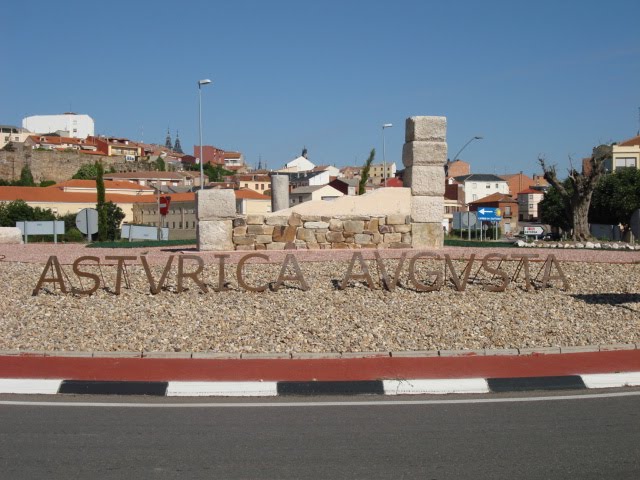
We got to Astorga (notice the name, Augusta - another reminder of home!), another city on a hill, and climbed up into the old part. We followed the guide book´s suggested route through the old, walled part of the city which meanders through a series of plazas.


Off of the first plaza was a lovely garden, with views over the city walls into the new parts of the city below, and far off into the distance towards the mountains that we will be crossing in the next couple of days. There was also a church which St. Francis reputedly stopped in on his way to Santiago (think: George Washington slept here, because there are a number of places that claim this).

Next to the church were archealogical ruins from Roman times complete with mosaic floor tiles intact. A street sweeper, in his orange jumpsuit (they are very fastidious about keeping the streets clean) stopped to tell us about the ruins. Stella got his picture. She is much better about taking pictures of people than I am. We will run into him twice more before we leave the city. He will tell us about the animated clock on the city hall and also help us find a tobacco shop which is where they sell postage stamps. He is our little 'guardian angel' for Astorga.


We wound our way up the street which serves as the spine of the old city. We stopped in the Plaza Mayor, where the City Hall and the clock are and waited a few minutes for the woman and man characters to do their thing and strike the big bells on the hour. We checked out the Museum of Chocolate, but decide it was not worth the price of admission (which is saying a lot, considering Stella's passion for chocolate!). We got a few postcards, wrote them, got stamps at the tobacco store, and put them in the round, bright yellow "Correo" mailbox and then went to find the Cathedral. I liked the cathedral more than the one in Leon. It, too is Gothic, but somehow seems lighter, airier. There are a variety of stained glass window styles within the cathedral from several centuries old to very modern. .


Next to the Cathedral is another Gaudi building. This one is his palace for the Bishop of Astorga. Built in 1887, it is a rather grand parady of the Gothic style, emphasizing horizontal rather than vertical, but with spires and turrets and gargoyles enough to make any Gothic-o-phile happy. We didn't take the tour, but the inside was supposed to be designed to be spectacularly ornate, with sumptuously appointed salons. Hmmm..."even the birds of the air have their nests, but the Son of Man has nowhere to lay his head..." What Would Jesus Think? Just sayin... The bishop died only six years after the building was begun and so construction was halted, and it was considered a church scandal. Astorga was a poor region and this was outrageous. The building was eventually finished in 1909, but succeeding bishops were embarrassed (and rightfully so) to live there. Finally, in the 1960's, it became the museum it is today. Outside of the Gaudi building, there is a garden area, again overlooking the newer sections of the city below, with three larger-than-life statues, of which this is one.


We have a somewhat pricey, but tasty open-air lunch of salads, good bread and beer in the Cathedral plaza before we say goodbye to Astorga. As we are walking through the outskirts of Astorga, we see a much more modern church and this relief, which says "Camino" over and over again both horizontally and vertically, is a piece of art on the side of it.


It´s another 10 km to Santa Catalina. Halfway there, we stop in a little town to take a brief break. It´s one of the prettiest little bars we have found. The lady who runs it is a character. She asks where we are from and we say "USA". Before we even say "Georgia", guess what she puts on the CD player? Yep, Ray Charles singing "Georgia." (Remember a Spanish version of "Dixie" coming out of someone´s window in Castrojeriz? Hmmmm) Anyway, we got her picture and she wants us to send it back to her via email so she can post it on her wall.

Another 5 km to our home for the night. I thought it flew by and I got here in about 45 minutes - I was trying to beat the rainclouds. I couldn´t believe this was the right town already. Stella, who was walking separately and listening to her MP3 player, thought she would never get here, though she was only about 15 minutes behind me. Sometimes it´s all a matter of perspective. Anyway, it seems like a much more comfortable place than last night. USA just tied with Slovenia (I think) in the World Cup. It´s time to sign off and go explore the town a bit.

Back again for a final closing. Stella and I explored the length and breadth of Santa Catalina. Didn´t take too long. It is apparently a typical town of the Maragota culture. I am not quite sure what that means except it is a subculture that goes back to the 7th or 8th century. There is debate as to whether it has Moorish origins or is named for a former king. It is in pockets up in the mountains of Spain, very isolated. There is traditional dress and food. Other than that, I´m not sure what makes it different, perhaps life customs such as weddings. I don´t see much difference in architecture or layout of towns. Stella and I both get into phazes of picture taking. We´re now into doors. People have interesting old (and sometimes new) doors that are often painted bright colors. Sometimes they were painted bright colors in the past and have washed out. Blue and green seem to be favorites. Some doors have ornate carving or really interesting hardware. Others are arched. Some of these doors are large, double doors that simply open to garages or places where farm equipment is stored on the ground level and living quarters are above. This town has a number of pretty doors.

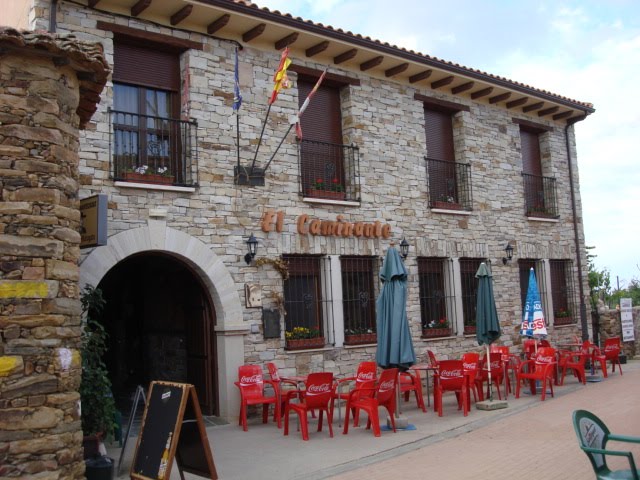
This alburgue, El Caminante, which must mean something like "the walk" or "the hiker" or something to do with walking, is pretty, with a central courtyard filled with a fountain and pretty flowers. And they have invited swallows to build nests up on the second level. Their chirping fills the courtyard with cheerfulness. Out behind the courtyard is the tendedero, the washline and a utilitarian courtyard. In that courtyard is a black cat and a family of siamese looking cats. There are a momma and daddy and three blue-eyed nursing kitties that are perhaps three months or so old, all living in a plastic soda crate. They are very cute and help my craving for a fix of my own kitties.

There are no other businesses in town beyond the two alburgues, so we have dinner at ours. It consists of the required red wine and water, a sopa verde that is creamed green something and very tasty with the thin sliced crusty bread, and then, once again, fried fish. There is so much fish, that I leave a good portion behind along with all the fries and the slice of tomato. Dessert is real, homemade flan, a little granular, but sure beats the commercial stuff in a cup!