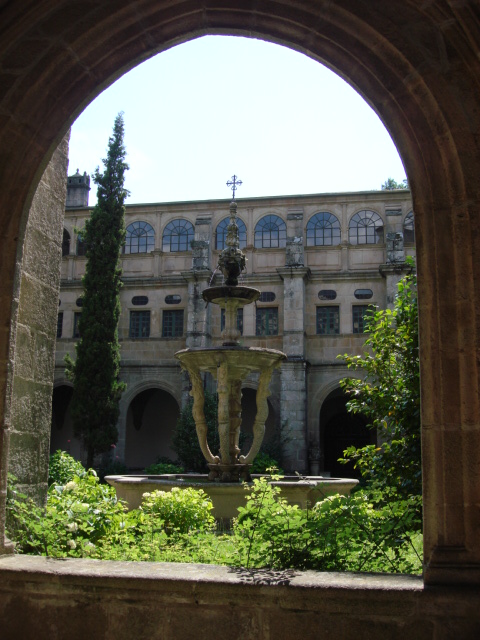
Samos to Ferreiros (Friday, June 25th)
We left our beautiful alburgue in Samos early.
 There was a nice little park between the road and a little river down below with the seemingly requisite pilgrim statue in it on the way out of town.
A lot of the early part of today's walking was wooded and cool. It is very beautiful and, again, almost as if we are walking in a fairytale land.
 One expects elves or gnomes or some other mythic creatures to appear at almost any time from out behind the trees. Is it any wonder when there are trees like this as part of our journey this day? When I came up to this tree, I stopped to read the sign. And as I stood there, I heard a groan. For a moment, I truly considered the possibility that it was the tree groaning. Wouldn't you? I looked at the tree very hard, expecting to see a face in it somewhere and almost expecting it next to speak, like something out of a movie. Then, I slowly started to walk around the tree on the trail - only to find a pilgrim laid out on the ground, stretching and resting, and groaning! I laughed to myself, and I was glad that I hadn't been on canded camera (or maybe I was!)
  There is lots of flora to look at, if not so much fauna. We hear the birds calling in the woods.
Though much of our walking this morning was in woods, we did occasionally come across a lone Galician farmhouse or a small village, which generally reminded us of just how poor this area is.
 The farmer who lives in this house was not far away and I tried to take this picture without him seeing me because I was self-conscious of taking it. I can't imagine living in a house in the condition this one is in. But perhaps the man cannot imagine living any other way, I don't know. This second picture was taken at a much nicer house that had a sign reading "rectory." I have no idea if it means the same thing there or not. The house happened to sit at a choice in paths and the signs were less than helpful to a number of us pilgrims who gathered trying to discern which way to go. While the others tried to figure it out, I decided to take a picture of this traditional Galician cart.
  Stella caught up to me a few minutes after all the other pilgrims took off in one of the directions and we followed. A short while later, we posed by yet another kind of Camino sign while another pilgrim took our picture:
We enter the city of Sarria a little while later. They are doing a lot of construction on the street on which we enter. There is a Visitor's Office, so we go in and get a map, which is helpful. A picture on the map shows that they have a Corpus Christi flower display here, too. Sarria is an interesting looking city. the first part is fairly flat, and then it becomes the city of 69,000 steps (only a slight exaggeration!) At the bridge where we cross the river (Rio Sarria), there are lots of caravans that look like they they are sort of permanently set up, but they are not open for business right now and the flaps are all pulled down. We have also noticed electric decorations across a lot of the streets.
 Apparently they have festivals and a fair at least once a month with all of these vendors. They have also just had a major festival as we find out when we duck into a church and they are just putting away one of those wagons with figures on it. On the other side of the river is where we begin all of the steps, and if it isn't steps, it is a very steep incline up the Calle Mayor.
  At one point, we pause for a breather and talk to a nice guy who snaps our picture.
  At the very top, we are at least rewarded with a beautiful view of the city below at the Praza San Roque. It's funny. You probably expected that to be Plaza, but it really is Praza. The dialects and spellings have changed several times as we have hiked through provinces and regions and peoples. Keeps pilgrims on their toes!
From Sarria, we head back into the countryside again. As I enter one small village, it is apparently time for the cows to come home. The path I am walking on is perhaps five or six feet wide and defined by stacked rock walls on either side. The cows are in a small field, also defined by rock walls around it, ahead off to the left. The farmer has come to call the cows with her trusty herding dog, opens the gate, then turns and heads back up the path. Most of the cows are smart enough to come back out the gate onto the path, turn left and head back up to the barn-house for milking or feeding or whatever normally awaits them this time of day. But not one lone cow who decides to rebel! She will have none of this following the herd mentality today! She wants to turn right and come down the path towards me! Aaagh! I stop in my tracks while I'm watching all this happen.
 I can see myself getting flattened into a pancake against the rock wall by this 800 pounds of bovine tempest ahead of me and I'm not enthralled with that prospect. But the dog will brook no rebels this day (or probably any other, either). The dog is firm and keeps barking and running around in front of the cow, nipping at the cow's hooves, not letting the cow go the way it wants to go. The cow bellows. The dog growls. The cow stomps. The dog barks louder. I still haven't moved, because there really isn't anywhere for me to go. And - I'm mesmerized! Finally, the dog gets the upper paw and the cow caves. The cow goes running back to catch up with the others. One can almost hear the dog going "Yes!" rather gloatingly. All in a day's work. I was too busy being mesmerized to get any good pictures of it, but I did get this fine fellow strutting and crowing his stuff as I passed a farm:
Not long after, I pass this very important marker. It is the 100 kilometer marker. That's all the further we have to Santiago!!! Hard to believe, from that first sign we saw at Roncevalles for 870 kilometers. Wow. In order to receive the Compostela, the special certificate, pilgrims have to physically walk the last 100 kilometers. (or do whatever means they are claiming) Another way to look at it is, you only have to do 100 km to get the certificate, which is what some people do, so the traffic picks up a lot from this point on. They actually have "police" checking to see that nobody cheats! So all the rest of what we have walked is icing on the cake in once sense, but for us, we have the experiences, the graces, the strength we have gained, the personal satisfaction of having walked the hundreds of miles that have preceded these last 62 or so. I have my two little rocks from Jerry Hall road with me. And I pull one out and place it on top of the marker. It's the little one on the very top, just to the left of center.
 This marker, too, makes it very real that our adventure is beginning to come to an end. We're not quite sure we want to think about that just yet.
Not too long before I reach our destination for the night, I come to a woodsy area that has a creek running through it. The creek is shallow but very broad. The people who maintain the Camino have come up with an intriguing solution for the path to keep our feet dry!

Not long after, I enter the little village of Ferreiros where our hostel is. You might guess by looking at it's name that the town has something to do with iron, and the town's name actually means "blacksmiths." There don't seem to be any forges or blacksmiths in sight any longer, however. The hostel is one of the not-terribly attractive, but functional government-run white and blue buildings that looks like a big FEMA trailer. It holds only 18 pilgrims and I am #14. I hope that Stella is not too far behind. She gets in at #17! The bathroom is not great (Stella is so much more tolerable about these things than I am!) But at least we have a bed for the night. There is a rainstorm after we get settled. Afterwards, we have a beer at the little cafe next door. There isn't much of anywhere to explore, but we head down the road and discover a little restaurant. Apparently, it also has an alburgue - if only we'd known! We have a delightful dinner with a very funny waitress.
 We'll be back in the morning for coffee and tea before we hit the road. As always, the World Cup is on the TV. We climb back up the hill to our no-frills alburgue - well, they gave us mattress and pillow covers in case of bedbugs, I guess that's a frill!
Ferreiros to Ventas de Noran (Saturday, June 26th)
We're out of our trailer-alburgue early and eager to get down the hill for cups of caffe and tee. Then it's off into the early morning mist again.
 A few kilometers down the road, we begin to hear music wafting through the air. It's Celtic and lilting. It seems so appropriate coming to us through these ancient trees. We're in an area of a little bit of settlement and the music is getting louder. Fiddles and pipes. It's coming from behind a wooden enclosure - we go in the gate only to find a wonderful little spot for a break. A woman has reclaimed (with pictures to prove it!) a derelict set of buildings and turned them into a fabulous little alburgue and cafe.
  Too bad we didn't know about this last night! But then we wouldn't have had our fun dinner. It's a lovely spot, especially since we are still in the morning mist of the mountains. Finally, we get up to go on as others arrive.
 We begin to descend out of the mountains towards the Rio Mino, where we can once again see vineyards. Especially as we get close to the city of Portomarin. Actually, the new city. The original city dated back, perhaps, to Roman times. It had a bridge at least as early as the 10th century. It was a very strategic location, however, so the bridge was destroyed numerous times in various conquests. Until the 1800's, it was also an important commercial center, but developing roadways took traffic elsewhere, so the city shrank. In the 1950's, work began on a major dam and resevoir in order to provide hydroelectricity for the region. Only the most major monuments - the Romanesque churches of San Pedro and San Nicolas (now San Xoan), and the old manor house - were removed to the higher ground where the new city stands, and everything else was flooded. We get a good view of the new city before we cross over.
When the water is lower, you are supposed to be able to see the ruins, but we were not able to see anything. There is just a narrow walkway along the bridge on one side next to the auto traffic.
 Fortunately, it wasn't too busy on this Saturday morning as we were crossing, as it didn't feel very wide to me. I was glad to be on the other side! Once again, we had to climb UP to get where we were going. One lady had two little matching dogs that seemed to have free reign of the whole town because we kept seeing them everywhere and they weren't paying a bit of attention to her efforts to recall them. We took our time walking around the new city, getting a few things to eat for lunch at the grocery and sitting in the square, people-watching for awhile.
  We also went into San Xoan. In leaving Portomarin, we had to go across a rather rickety looking footbridge across a river, but it held.
From Portomarin, our journey this day is mostly through fields and groves
 and through some tiny gatherings of houses and farms such as Toxibo and Gonzar, until we reach our final destination, the lovely little community of Ventas de Naron. This community has no more than a handful of buildings with a couple of alburgues and cafes, but it seems so idyllic with the sheepfold in the middle of all of it!
  I get registered in the alburgue and grab a bunk, and put down my backpack, then go downstairs to grab a bite to eat and a glass of wine. Stella shows up just about then and, after she gets settled, comes out to join me. As I glance out our window later, this is the view:
  If sheep may safely graze, then I think we will sleep well here tonight! We share our room with a woman 'a caballo' pilgrim who has a lame horse, but the rest of the bunks remain empty. There is a bit of a rain shower so we have to relocate our laundry quickly under a porch roof. When laundry isn't dry by morning, we just tie it on to the back of our pack and let it air out until it's ready, then stick it away! We have a nice little dinner at our alburgue - there really isn't much choice here. Then ba-a-a-ck to our room to sleep.
Ventas de Noran to Melide (Sunday, June 27th)
Almost all of the last week we haven´t had internet access, so it is a lot to catch up on. I will start with today and as I can, I will fill back in. Guess what? We are 31 miles from Santiago as of tonight!!! Wee Haw! Stella and I did 18 miles, more than 27 km today, plus a few late this afternoon trying to find a place to stay here in Melide. We had planned to have a shorter day, about 18 km, but we got to where we were going to stay, Vilar Casanova, and found that it was not a great alburgue. It was also in the middle of nowhere with nothing of interest around it, and it was only about 12:30. We would have been bored for the rest of the afternoon, so we decided to do about 10 km more and get a little further down the road. We had thought that Melide was supposed to be a little more medieval and attractive than it is, but apparently it is not. It is, however more of a city, and we did have stuff to do this afternoon (walk, walk, walk, look for a place to stay, walk).
It was a gorgeous day. We have been blessed in our weather. Other than the first mountain crossing and the three days of rain on the meseta, we have had lovely and cool weather. We have had rain twice in the evenings after we have arrived, including last evening. Today started out foggy and cool and stayed nice and cool all day until late this afternoon. Today´s walk was mostly wooded and shady, and a good bit downhill and not so steep. There are few villages along the way, but here and there a farm or two. As we left Ventas de Noran, we passed the Cross of Lameiros, which dates from 1672.

There are lots of interesting characters to meet on the Camino. Today, we met John de Verra, a retiree from London, England, but whose family was originally from Verra, Spain. His ancestor fought on the losing side in the Battle of Trafalgar, but eventually became a chandler in the British Navy (we got the WHOLE story). He was quite a character. Travels Europe in his RV now, no strings attached. Made it quite clear, first to me and then to Stella when she came up, that he was looking for a traveling partner. He really was very lonely and was just looking for someone with whom to converse in English. Stella was brave enough to have a cup of coffee with him. If you´ve ever watched the Britcoms and you know what Onslow and Daisy´s dishware looks like on ¨Keeping Up Appearances,¨you´ve got a good idea about how clean (or not) it all was! John used to be a stage director for a West End Theatre and then he was in TV production for a couple of decades for British TV before he was downsized. Now, he wants to travel Italy from top to bottom and France and a few other places. Mostly, he just wants company.
The rest of the journey today was through quiet shaded paths. One of my pre-arrival questions was, are there squirrels in Spain? Well, the answer is yes. But not many. In all the woods and forests and parks and trees that we have walked through and by, I have seen a grand total of two (yes, two) and Stella has seen one. And they are not grey like the ones we have in the US, but dark brown, like the color of a mink coat. I did see something about the same shade of gray in a farmyard yesterday, only it was much bigger. And it had bigger haunches. I didn´t get to see it very well. I suppose it could have been a bunny. But I really think it was more like a very big rat. It certainly wasn´t a cat.
After the big park in which we meet John, and the other woods, we reach the little city of Palas do Rei. For a change, we find ourselves going DOWNhill through much of it.
 There are some interesting things to see. We poke our head into a church. It is quiet and cool inside.
  We make a pitstop for lunch in a nice little bar/cafe. I got tired of the heavy cheese sandwiches (and I REALLY can't stand the fatty meats in other sandwiches) weeks ago, so I often get a 'huevos francese' sandwich, which is somewhere between scrambled and fried eggs in between bread. Most of the heavy, chunky bread gets left behind. I am looking forward to lighter, fresher meals!
 As we are headed out of Palas do Rei on the other side of town, we find this lovely two-pilgrim statue in a dance. It's hard to get a good picture of it.
 In Galicia, the Camino is marked more poorly than anywhere else, and we have a moment when we cannot figure out where we are supposed to go. Again, as if God has provided a guardian angel, a man appears from nowhere and points us where we need to go. I know it is obvious that we are pilgrims and I'm sure it is obvious by our faces that we are confused, but we have just been helped like this more times than we can count!
We continue to walk through shady, mostly wooded lands today. We are in the province of A Coruna. We notice for the first time that they have placed litter barrels along the way - and the pilgrims are using them! It's one of the cleaner segments of the Camino! It is very pretty countryside. We stop at a really nice little cafe for a break and they have some interesting clay Celtic jewelry for sale. I find a necklace for Stella as both a birthday present and a memento of our journey together, and a similar one for Mom. Both of them remind me of the pilgrim statue we just saw in Palas do Rei - it is two people dancing, dressed in traditional Galician attire. For Stella, it is a reminder of the wonderful marriage she has with Dave, with whom she has been through so much and who at this very moment is at home redoing her entire kitchen for her! And for Mom, it reminds me of the dance she had with my dad for 53 years.
We meet some more animal friends along the way.
 Momma is very proud of her baby and is happy to let us scratch her and her baby's ears and muzzles. We are in and out of woodlands, and it is such a peaceful walk.
  Where there are homes, people invariably have at least one corn crib of a very distinct style. The Spanish (or Galician) name for them is "horreo."
  I don't really understand the attachment to these corncribs. Even when the homes are in a more suburban area, people will have small, concrete horreos in their yards, like we might have a birdbath. There are small decorative ones made in any material you can imagine to put on your coffeetable or bookshelf, should you so desire!
  It would seem that everyone in Spain has a green thumb. The blooms along this part of the Camino, despite the woods and shade in many parts, are vivid colors. People grow flowers everywhere they can and the climate certainly favors it.

Along the way, there is a monument with this Cross of St. James on it.

I'm a little ahead of Stella as I finally reach Melide and cross over this beautiful, stone arch bridge.
 It is a hot climb up a hill after this. Once again, I'm not sure where to find an alburgue (what was once an alburgue is no longer), and I wait for a while at an intersection where I think Stella can't miss me, but it gets hot, so I wander closer in to the older part of the city. I find a place to sit, at least, and take off the pack. At last, Stella arrives. We decide to have some alemandrado blanco (of course!) before going one more step. We notice a sign on the door for rooms at this little cafe. We go into the city a few blocks further and find that the one main alburgue has been closed and so the other is full. We do not feel like going any further for the night and so we quickly go back to the place where we had the ice cream to see if those rooms are still available. They are and so we splurge monetarily and get one. It is not wonderful except that it is private and, once again, we have real beds instead of bunk beds.
 After getting settled in, we go downstairs where we know they have some computers available and try to catch up with some emails home. Then we head out to explore the city some more. It is an interesting little place, though not as attractive as we had expected from the guidebook description. The city is considered the "geographical heart of Galicia." The core of the city is medieval with several old churches and some other buildings. There's a museum here, too.
It is interesting being a pilgrim versus a tourist. There is part of the history and story that we are taking in, and we did the tour of the monastery in Samos, but it is different. The focus is more on the journey and the bigger picture perhaps, not the details? I'm not sure that's really right. Here's another stab at the difference. Tourism is about learning all there is to know about some place - the history and the people and the culture. Pilgrimage is about getting quiet and walking into the depths of the experience of it in time and space. Allowing what is important to saturate you and what is not to slip off. That's closer. It may still be not quite right. Allowing space for what God wants to show you in a particular place and time. Getting closer to what the difference is. There are times when I wish we had more time or energy or money to stop and look at interesting things, although then I wonder why - would I really remember it in the blur of all we have experienced? Now, I remember things about how the layers of leaves felt on the mountain, and how the rain felt like a water pic on the meseta and how sometimes it was all I could do to put one foot in front of the other as prayer to say yes to God, and somehow this is more important to me as pilgrimage. Or the conversations I have had and the faces of people I've met, and I think that is the take home, not some display some place in a building.
We have dinner at a little restaurant on the corner of the main streets in downtown. It is wonderful watching everyone go by on this sunny Sunday evening. I'm getting sadder that our great adventure is getting closer to its end, but excited to be reaching our goal. It's such an odd mix of feelings. I can't wait to get to better, healthier food, but I love being outdoors, seeing new places, meeting wonderful people. We walk slowly back to our home for the night.