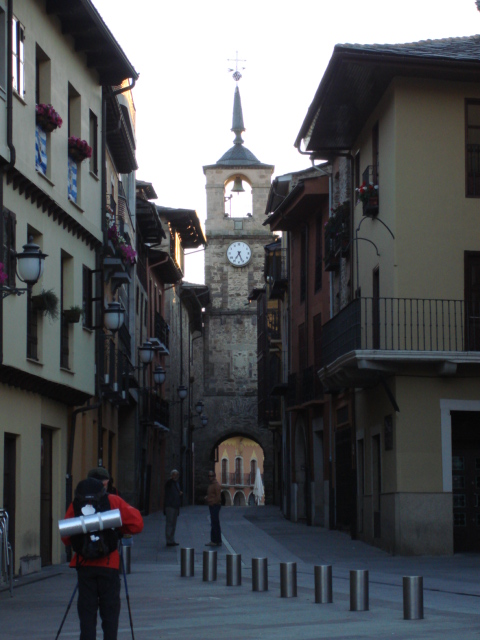
Ponferrada to Villafranca del Bierzo (Monday, June 21st)
Today was a long day, even though it didn´t seem like it really should be, and especially since we took a ´short cut' - but you know how those go. We left Ponferrada and were pretty happy to do so. This was the dirtiest of all the towns and cities to which we have been. By far, it has also had the most graffiti, with lots of it appearing to be gang logos, claiming various buildings or properties, like dogs marking their turf. As Mac Davis used to sing about Lubbock, TX, it was good to have Ponferrada in our rearview mirror.
There was a section of the downtown where there was public art

and some older buildings,

but the "nice" part of the city was minimal. On the way out of the city, as soon as we are out of the grafitti-laden area, we stop for coffee and tea and toast at a little pastry shop. There are only three others there when we first arrive, but the place quickly fills with other pilgrims and a couple of locals right after us. Once we are back on the road, the Camino routes us through a neighborhood that seems very American - two story, larger homes with large yards, 'curb appeal', drive ways, etc. Very different from what we have seen before. Somewhere in this neighborhood, we find a church with murals painted all around the exterior of it.


Then, for only the second time on the Camino, we are routed through a building. As we are leaving, we pass a site where an old factory building is being preserved and re-purposed into offices and condos. Not far away, there is a very modern, but not attractive building that looks like a couple of dominos precariously balanced on one another. Then we are finally out of the city and breathing country air again.

As we walk through the countryside, we notice that they have erected poles

specifically to encourage storks to nest and we realize that we haven't noticed as many storks' nests in the cities and villages lately. Perhaps the architecture in this region doesn't lend itself as well to being hospitable?
We stop in a little village for some limonade part way through the morning as it is already hot and take a load off our feet at the little table and chairs outside. There is a small chapel which actually sits in the middle of the road just in front of the cafe.

The inscription above the door says it is 15th century. Notice the pilgrim art used as a gate so that you can observe the inside but not go in.

In this area, we discover yet another way of marking the Camino when we are out in the countryside! We walk through an area with several small towns, and for the first time, find ´country homes,´ where people live in between towns. Up until now, there have been almost no houses anywhere except in villages or cities, but here, there are actually farmhouses and ´suburbia.´ We also enter into the town of Cacabelos, known, as the signs said, as one of the major wine city-areas in Europe. Alas, we do not have the opportunity to partake of any of it. But it is a very attractive area and a pretty little city.
Villafranca is our destination for the evening. We have an option of going two ways. We take the ´shortcut´ which supposedly saves two kilometers. What the guidebook doesn't tell us is that the entire way is UP hill. Or it certainly seems like. In retrospect, I do remember one downhill stretch along the road, where I was looking up at the next uphill stretch! It is one of the hottest afternoons on the Camino. Much of the path is a dusty road through fields. Along the way, we pass a place that manufactures what have to be some of the ugliest and largest yard art available.


I just don´t think I can go around another bend and see another uphill looking at me when our trail finally comes out on the other one. If that was the shortcut, I would hate to see the long one. Those people (the ones who DIDN'T take the short cut) look quite refreshed. Hmmm...
The city of Villafranca is very interesting. As we first come into the city, we see the 12th century Romanesque church which was originally a substitute for pilgrims who could absolutely not make it any further to Santiago. The road from this point on, especially in previous centuries, was very difficult. The church has a beautiful, carved big door that was called the Door of Pardon (Puerta de Pardon). Pilgrims could enter there and receive the same absolution that they would have if they had gone the whole way. This door is opened only during the Holy or Anniversary years.
There was also a beautiful castle built in the 16th century for Peter of Toledo, and the convent at the Church of St. Francis of Assisi, as well as other interesting buildings. Like many of the towns and cities, there is a river running through the middle of the city, and part of the city is built into the rocky hillsides. Our alburgue was the whole way through town, and across the bridge,

but it was worth it. Called¨"La Piedra,¨the Rock, it was built into the rock wall of the mountain and had rock coming into the building on every level. It was magnificent and a lovely place to spend the night. I wish I had taken pictures of this alburgue, but alas, I did not.
A flyer in the alburgue advertised back and leg massages. I asked the young woman who checked us in about it; turns out, the massage therapist was her mother. So I booked a 5:30 appointment to have her mother work on my legs, especially my calves, which are extremely tight and bothering me a lot. We did our usual routine of cleaning up and laundry - there is only a very tiny place to hang it out the back window in between the building and the rock wall and heaven help it if you should drop a piece! There are also a few racks inside, but it doesn't seem as if it will dry well, so we only wash what we have to. While I'm waiting for 5:30, I tried to use the one computer, but a man was hogging it, so I spent time downloading pictures from my camera to my netbook and trie to label some of them. About 5:00 pm, the massage therapist showed up and opened up her table, right in the middle of our top floor dormitory. She had a 5:00 pm appointment with a man who had been keeping about the same pace as us for a number of days. He's dark haired, nicely built - Spanish, I think, because they chattered on quite a bit. Apparently he was going for the works. Towards 5:30, I started to pack up my stuff and move towards the edge of my bunk, making it look like I am ready for my turn. She made no effort to stop at my time. She went on, taking very good care of every one of his poor muscles until about 5:50, and as soon as he hopped off the table, she suddenly started to fold up the table! "But wait, I was your 5:30 appointment!" I call out, and of course she looked purposefully vague. She said that her daughter forgot to tell her about me. Hmmmmm. I am not a nice, dark haired, good looking Spanish man. She said she had to go to another town and she was to be there by 6:00. But I was in too much distress with the tightness in my muscles to let her go so easily, so I forced her into a massage. She took it out on my legs; it is all I could do to grab the edge of the table and grit my teeth not to scream. I have had deep tissue massage, and I knew my legs were in distress before, but this is something else! She probably loosens some of the muscles, but for the next week, I have bruises all over my legs where her fingers have pressed too hard. So I guess she ended up with the last word. It was still a hurried massage and she rushed out.
After I was through with the massage-torture, Stella and I walked back into the city to look around and get something to eat. We run into Ale from Argentina again and he told us that Charlie was there as well. It turns out that Ale has ancestors from this city, and so he was looking up some of his family roots. It was also Charlies' birthday, so he was celebrating somewhere. Ale was on his way to the cathedral for a service, so we parted and continued to wander through the streets. We found our way to the square where there were a number of open-air cafes.

We were already eating when who should come up to us but Ed & Terry from NY and Ronnie from FL again, as well as a couple of other familiar pilgrim faces. And guess what? The massage therapist who had somehow made it back from the other city and is having dinner with a couple of gentleman friends. Hmmmm. Again. Villafranca is a really enjoyable little city - very walkable. As we were walking back to the alburgue, we met an inscrutable cat, staring out from an open window of a delapidated building, right next to the bridge over the river. His attitude reminds me of the Cheshire cat from Alice in Wonderland. We didn't seem to bother him at all. I think he takes a lot of the world in from his perch there.

As we are settling in for the night in this otherwise lovely alburgue, the woman on the lower bunk nearest ours comes in. She begins, seemingly in the slowest manner possible, to unpack shall we say, on the conservative side, 4328 plastic bags or other things that rustle from her backpack. It takes her forever. She is oblivious to the rather disgusted sound of both Stella below me and I on the top bunk tossing and turning, and coughing, and clearing our throats, and sighing loudly. And in the midst of it, the younger woman who is with her, possibly her daughter comes in. They get into a somewhat heated discussion. Stella and I are both afraid (as I later find out) that the younger woman does not like how the older woman has been re-packing and she wants her to start all over again. It is all very inconsiderate of everyone else in the dormitory who have all gone to bed (but not to sleep) already. Apparently at some point, they finish their rearranging of everything, and equally apparently I know I eventually drift off to sleep. Needless to say, we are not so very quiet as we are preparing to leave in the morning and they are still in bed!

 Today, we conquered the second mountain, O´Cebreiro! As Stella came up over the crest, she held up her arms ala Rocky, tada!
  O´Cebreiro (pronounced Oh-thay-bray-ERE-a, according to our guidebook), is 1300 meters, and actually, we also crossed Alto de Poio (or O Poio), at 1337 meters, the highest point in Galicia and on our trip, a short time later. Even though we had dreaded this mountain a little, it wasn´t so bad. The first third, from Herrerias up to La Faba was a little difficult.
  At first we shared asphalt with the cyclists, but quickly branched off onto wooded, steep and rocky paths. There was actually a section, though, that seemed rather like a little hidden paradise, a bit primordial, and, as no other pilgrim was immediately in sight before or behind me, I felt as if it was just for me to savor. As if I were an Eve in my very own Garden of Eden. I stayed there a few extra moments, a welcome break during the most arduous part of the morning. Then, I finished the steep climb up to La Faba and I was quite ready to get there. On leaving the little village, I was slightly confused by the yellow arrow and couldn´t tell which of the paths to take, left towards the fountain, or straight ahead. As has happened so many times, a person, or perhaps a guardian angel, just appears out of nowhere and points the way. Stella says we have big 'L´s' on our foreheads for ¨lost¨ and everyone in any town just seems to know what we need and where to take us. It has happened so many times it´s amazing. So this guy just appears out of nowhere and indicates that I´m to take the straight ahead path. Only then do I see the other yellow arrow which says that, too. Meanwhile, he´s asking me where I´m from and I tell him Ëstasdos Unidos. He tells me (he has to tell me twice before I understand him) that the people who live in the very house we are standing in front of are from the US, specifically Connecticut. Who would choose to live in this out-of-the-way village? Nice house. Definitely someone who wants to REALLY get away! Thanks to this man´s assistance, I am on my way again.
  The second third, to La Laguna de Castilla, is much less steep and more open, less rocky. I take a break at a little bar-cafe in Laguna. Two little minivans let out a group of older touristy Camino travelers who don't really look like they are dressed for hiking. I assume they are just going to do this one segment up to the top of the mountain, but I will end up seeing them a couple of days later. It seems they travel by van from place to place with a guide and walk selected short sections with little day packs. Everyone does the camino their own way, rather like life. The last part of the mountain is not so demanding either. And the whole way up is just one breathtaking view after another. I periodically pause just to take it all in - not like on the way to Hunnto because I have to, but because I want to; it is just so beautiful and my pictures don't begin to do it justice. I have no idea how many miles we can see for across the valleys to other peaks. It´s a long ways. We have entered the province of Galicia a short while before reaching the top of the mountain. At this point, there are only 152 km to Santiago! At the top of the mountain is a reconstructed little Galician Village.
  Galicia is one of the poorest regions of Spain. The buildings are stone. Corners are often rounded, I think so that spirits cannot hide in them, but I might be confusing cultures. The design is pre-Roman in origin and they are called pallozas.
  Roofs here are slate shingles or perhaps thickly thatched. The only original buildings at the top are the church, Santa Maria a Real do Cebreiro,
  which is one of the oldest (pre-Romanesque) churches along the entire pilgrimage route, and the hospital (in the care of pilgrims, not like we think of it) connected to it, which dates to the 9th century. There is also a memorial
  dedicated to the man responsible for the Camino the way it is today and developing the way of marking it with the yellow arrows. I step into the church and there is a mass being said in German.
  I listen for awhile and am able to follow along with a lot of it. I go back out to the topmost point of the mountain and take a 360 degree look around the surrounding countryside. There is also a monument at the top marking the spot where a pilgrim, lost below in the fog, heard the sound of bagpipes being played and was led to the top of the mountain where he found safety and shelter.
  There is another marker commemorating a 14th c. miracle, when a less-believing parishioner actually saw the bread and wine turn to the body and blood of Christ, the Holy Grail, here. That miracle was later incorporated into the coat of arms of Galicia. Galicia has been Celtic for centuries, so there is a strong influence in the language and customs. I wait for Stella to catch up (tada!) and then we check out the little touristy shops. They have some nice things as well as schmaltzy. I find a pretty pair of Celtic design earrings for Laura who is looking after my mungos (Gaelic for beloveds) back home - Nicholas and Oliver. Stella picks up a few things for her granddaughters. Then we begin the trek down hill, well not quite downhill as there is a little bit taller mountain nearby (O Poio), but then we begin to descend. It's another gloriously sunny day. We walk mostly through woods, especially pines. We walk down and down and down.
  We pass through some small villages and by some farms. The poverty of Galicia makes it a 'no frills' kind of place. The people are practical to the bone. We end up for the day in the town of Fonfria, a very small town, the name of which derives from 'a cold fountain' that I never managed to find as I walked around later. The hostel is a bright spot in an otherwise incredibly bleak little town. All of the other buildings, at most 20, are concrete block, mostly two story, with cattle and farm equipment on the bottom floor and the human inhabitants on top. There is no ornamentation of any kind on any building except for the hostel and a small bar/cafe on the far end of the village - a whole 3-minute walk away, if you take your time. To get to the other end of the village, one has only to walk through the cow-manure, cow-pee, straw and farm equipment laden streets. There is nothing that is not of purpose here - absolutely everything has to do with the livelihood of these people. It's purposeful, but not exciting. I make several loops through the village because, after doing my laundry and not being able to take a nap due to the horrible choice of music playing in the bunkroom of the hostel and not being able to use the internet since the computer is broken, there is not much else to do. I did get a picture of a hound dog on a roof
  (haven't ever seen that before!), and I wondered how a dog gets on a roof - especially a dog that moves at about 1 mph - until I realize the back side of the house is built into the side of a hill! Stella comes out to walk as well and we explore around the small chapel and surrounding cemetery that don't look like they are ever used except for weddings and funerals and certainly not recently. The hostel itself is great, with a little cafe/bar in front, with a courtyard garden, a common room, a large bunk room and a big dining room and kitchen. We sit out in the courtyard with a couple of beers until dinner's ready. There isn't any other option for dinner besides the hostel, because the cafe really doesn't have much in the way of real food, but that's fine, even though dinner is late in coming.
  The dinner table is long and probably seats at least 25 or 30 folks. The multi-course dinner is wonderful, with soup and pasta and great bread and more. And the man and woman who serve it all up are fabulous.
  Stella and I are seated near several Germans who are anxious to get done and watch the World Cup match with the German team playing that night. (Unfortunately, they lose.) The young lady who sits next to me is a very extroverted, very engaging nurse who wants to become a midwife. She and the attractive, dark, curly-haired guy across from her have quite a verbal sparring match of wits during dinner. The young man to my left, at the end of the table, is from Venezuela. He and his wife are in Madrid where she has the power job and he is the stay-at-home dad to their small child. They both can't wait to get back to their home country, though. It is a very fun evening. Two mountains down; one to go.