St. James

St. James
St. James above the special anniversary door of the cathedral in Santiago

Friday, June 18, 2010

Progress

Santibanez to Santa Catalina (Friday, June 18th)

The beautiful, crystal blue skies continued today, and with a little added warmth. We left our rustic surroundings this morning and headed towards the old city of Astorga. Our route took us through more countryside. People here do not live out in the country. And a lot of what we saw wasn´t even cultivated, except a vineyard here, an acre or two there of wheat or corn or barley. It would seem like lonely countryside except that you feel the fullness of creation so present.

Not long after we started, there was some folk art along the trail that seemed like pilgrims themselves had created - which would mean folks had very intentionally brought along materials to create, and maybe others had added to over time. A little ways after this artwork, we went down into a hollow where there was a little lake with the mist still rising in the early morning sun. It was beautiful, with some waterbirds sitting on the lake and others rising up from it. A very tranquil scene with which to start the day.

We had about 10 km to Astorga this morning and stopped about half way for our break. This break location was much better than yesterday's! And we found yet another interesting way of marking the Camino along the way - and a little way to use some of the zillion rocks around here!

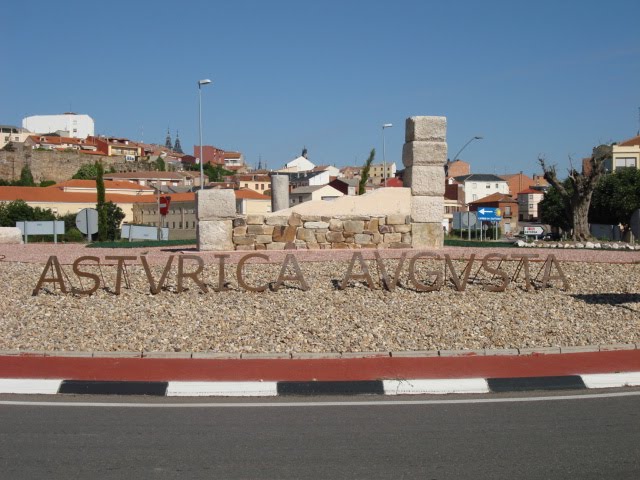
We got to Astorga (notice the name, Augusta - another reminder of home!), another city on a hill, and climbed up into the old part. We followed the guide book´s suggested route through the old, walled part of the city which meanders through a series of plazas.

Off of the first plaza was a lovely garden, with views over the city walls into the new parts of the city below, and far off into the distance towards the mountains that we will be crossing in the next couple of days. There was also a church which St. Francis reputedly stopped in on his way to Santiago (think: George Washington slept here, because there are a number of places that claim this).

Next to the church were archealogical ruins from Roman times complete with mosaic floor tiles intact. A street sweeper, in his orange jumpsuit (they are very fastidious about keeping the streets clean) stopped to tell us about the ruins. Stella got his picture. She is much better about taking pictures of people than I am. We will run into him twice more before we leave the city. He will tell us about the animated clock on the city hall and also help us find a tobacco shop which is where they sell postage stamps. He is our little 'guardian angel' for Astorga.


We wound our way up the street which serves as the spine of the old city. We stopped in the Plaza Mayor, where the City Hall and the clock are and waited a few minutes for the woman and man characters to do their thing and strike the big bells on the hour. We checked out the Museum of Chocolate, but decide it was not worth the price of admission (which is saying a lot, considering Stella's passion for chocolate!). We got a few postcards, wrote them, got stamps at the tobacco store, and put them in the round, bright yellow "Correo" mailbox and then went to find the Cathedral. I liked the cathedral more than the one in Leon. It, too is Gothic, but somehow seems lighter, airier. There are a variety of stained glass window styles within the cathedral from several centuries old to very modern. .


Next to the Cathedral is another Gaudi building. This one is his palace for the Bishop of Astorga. Built in 1887, it is a rather grand parady of the Gothic style, emphasizing horizontal rather than vertical, but with spires and turrets and gargoyles enough to make any Gothic-o-phile happy. We didn't take the tour, but the inside was supposed to be designed to be spectacularly ornate, with sumptuously appointed salons. Hmmm..."even the birds of the air have their nests, but the Son of Man has nowhere to lay his head..." What Would Jesus Think? Just sayin... The bishop died only six years after the building was begun and so construction was halted, and it was considered a church scandal. Astorga was a poor region and this was outrageous. The building was eventually finished in 1909, but succeeding bishops were embarrassed (and rightfully so) to live there. Finally, in the 1960's, it became the museum it is today. Outside of the Gaudi building, there is a garden area, again overlooking the newer sections of the city below, with three larger-than-life statues, of which this is one.


We have a somewhat pricey, but tasty open-air lunch of salads, good bread and beer in the Cathedral plaza before we say goodbye to Astorga. As we are walking through the outskirts of Astorga, we see a much more modern church and this relief, which says "Camino" over and over again both horizontally and vertically, is a piece of art on the side of it.


It´s another 10 km to Santa Catalina. Halfway there, we stop in a little town to take a brief break. It´s one of the prettiest little bars we have found. The lady who runs it is a character. She asks where we are from and we say "USA". Before we even say "Georgia", guess what she puts on the CD player? Yep, Ray Charles singing "Georgia." (Remember a Spanish version of "Dixie" coming out of someone´s window in Castrojeriz? Hmmmm) Anyway, we got her picture and she wants us to send it back to her via email so she can post it on her wall.

Another 5 km to our home for the night. I thought it flew by and I got here in about 45 minutes - I was trying to beat the rainclouds. I couldn´t believe this was the right town already. Stella, who was walking separately and listening to her MP3 player, thought she would never get here, though she was only about 15 minutes behind me. Sometimes it´s all a matter of perspective. Anyway, it seems like a much more comfortable place than last night. USA just tied with Slovenia (I think) in the World Cup. It´s time to sign off and go explore the town a bit.

Back again for a final closing. Stella and I explored the length and breadth of Santa Catalina. Didn´t take too long. It is apparently a typical town of the Maragota culture. I am not quite sure what that means except it is a subculture that goes back to the 7th or 8th century. There is debate as to whether it has Moorish origins or is named for a former king. It is in pockets up in the mountains of Spain, very isolated. There is traditional dress and food. Other than that, I´m not sure what makes it different, perhaps life customs such as weddings. I don´t see much difference in architecture or layout of towns. Stella and I both get into phazes of picture taking. We´re now into doors. People have interesting old (and sometimes new) doors that are often painted bright colors. Sometimes they were painted bright colors in the past and have washed out. Blue and green seem to be favorites. Some doors have ornate carving or really interesting hardware. Others are arched. Some of these doors are large, double doors that simply open to garages or places where farm equipment is stored on the ground level and living quarters are above. This town has a number of pretty doors.

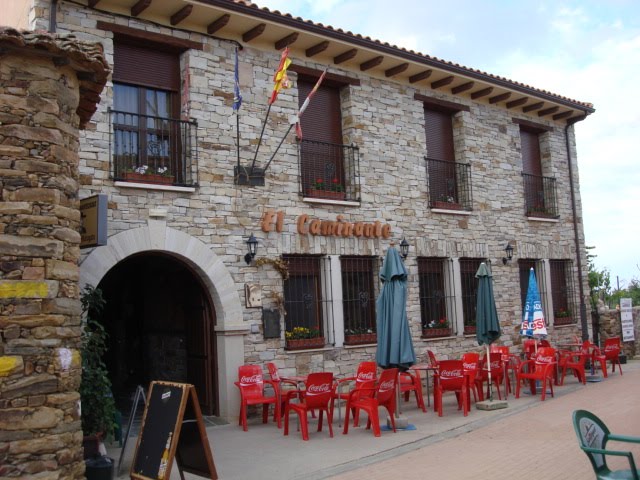
This alburgue, El Caminante, which must mean something like "the walk" or "the hiker" or something to do with walking, is pretty, with a central courtyard filled with a fountain and pretty flowers. And they have invited swallows to build nests up on the second level. Their chirping fills the courtyard with cheerfulness. Out behind the courtyard is the tendedero, the washline and a utilitarian courtyard. In that courtyard is a black cat and a family of siamese looking cats. There are a momma and daddy and three blue-eyed nursing kitties that are perhaps three months or so old, all living in a plastic soda crate. They are very cute and help my craving for a fix of my own kitties.

There are no other businesses in town beyond the two alburgues, so we have dinner at ours. It consists of the required red wine and water, a sopa verde that is creamed green something and very tasty with the thin sliced crusty bread, and then, once again, fried fish. There is so much fish, that I leave a good portion behind along with all the fries and the slice of tomato. Dessert is real, homemade flan, a little granular, but sure beats the commercial stuff in a cup!

Rustic

Villar de Mazarife to Santibaniz (Thursday, June 17th)

We have been blessed with beautiful walking weather the last few days. Cool temperatures, beautiful sunny skies. The path has not been marked as well in the Province of Leon, and we even have to step back in to Tio Pepe's and ask Rosey how to get back onto the Camino from the alburgue! But then we are on our way. All three stork families are awake and busy on the church bell tower on the little plaza in front of the alburgue.

We have about 20 km ahead of us this day with no major cities to go through. One village is completely concreted between buildings except for this little triangular rose garden. There is also a very clever ad on the side of a building for an alburgue:
We see a lot of older women out working in their gardens - they are dressed up like this one. I don't know the Spanish word for 'babushka.'


When we stop for our usual mid-morning break, it is an omen of what our accommodations will be like that night, we just don´t realize it. Each town seems to have one bar that serves the pilgrims as they drift through each day. The plastic tables and chairs, and sometimes umbrellas indicate their liveliness amidst the shuttered windows in most of these sleepy burgs. The tables and chairs are usually emblazoned with "San Miguel" or "Amstel" or whatever the bar features on tap. The pilgrims stop mostly to use the aseos, the bathrooms. Rare is it to find a bathroom on the Camino that has all four of these: toilet paper, soap, hot water, paper towels-hand dryer. If you can find one of these, it´s an okay place; if you find two, you´re doing pretty good. Well, this particular bar didn´t have any of the above, nor did it even have a seat on the toilet! Or napkins on the bar to dry hands. And the men´s room was worse - or so says Paul from the Chicago group, who is there at the same time as we are. So the ´rustic´ part of the day began early.

One of the cities that we did go through however, was Hospital de Orbigo which was famous for it´s jousting tournament in 1434 (I think). A knight, Suero de Quinones, who was a little crazy, was scorned by his lover (you can't really blame her when you hear more about him!), and therefore had to defend his honor. Which meant taking on 300 knights from all across Europe who rose to the challenge, but he prevailed against them all. It took 30 days, but he defeated them and kept his honor! And during this 30 days, there was apparently quite a party in the town with feasting, music and dancing. To this day, in fact, shortly before we got to the town, the city holds an annual jousting festival.


The bridge across the river is one of the longest medieval bridges still extant. As we were crossing it, there were men working on it to rebuild part of it. It has been damaged many times in major floods over the centuries, but is still essentially intact in it's original form. We walk across it, admiring the stonework and contemporary craftsmanship.

We decide to stop and have lunch in Hosptial de Orbiga and go into a little alimentacion. I buy some fruit, a granola-like bar and one or two other little things for lunch. We go out into the square to eat. There are lots of pilgrims present in this pleasant little town. The Chicago group, Paul, Therese, Taryn and Dana is here, too and we will say goodbye to them here as they will high-tail it from here to meet a deadline to get to Santiago and then to Rome. We also run into Ale (Argentina), Charley (Scotland) and Kim (England) again! It feels like old home week!

Hospital de Orbiga was also a town with an outpost of the Knights Templar in the church of St. John the Baptist who had a mission to protect the pilgrims who came through there. After our lunch break, we poke our heads into the little church. Outside are some lilies (the symbol of Mary) and red roses.


We got to Santibanez by about 1:15. The only alburgue didn´t open for another 15 minutes. The guide book says, ¨The bleak facade belies the charm inside.¨ Well, the inside turned out to be pretty bleak, too, once we were in. Stella and I were in a room about 9' by 9' with 3 bunk beds (i.e. 6 people) in it. The bunk beds were so short that the bar for the top bed hit the back of my neck when I tried to sit on the edge of my bed! Some places put fitted sheets on the mattresses and pillowcases on the pillows. Sometimes we trust them and sometimes we don´t and immediately get out our sleeping bags. This was an immediate sleeping bag place. And lavendar soap, to try and scare away any bedbugs. Or anything else. The two showers and two toilets for everyone (supposedly they could take up to 60 people in this alburgue) were outdoors in the courtyard, and the sinks, for doing laundry as well as washing hands and brushing teeth, were open air. This is why I don´t like camping. And yes, this is better than most camping. By the end of the afternoon, all six bunks in our room were full. There was almost no room for moving around by the time that everyone had their backpacks in there and unpacked what we needed for overnight. And this couple that was put into our room later absolutely roared with their snoring!

This is the only place so far that we have been absolutely bored. We walked around town a couple of times, laid on park benches in this beautiful little pocket park, loving the breezes and the smell of the roses wafting over us. But there was absolutely nothing to do. The town had no stores. The only bar in town closed at 2 pm, shortly after we got there, there was no Internet, and the alburgue was too damp and chilly to sit in. So for once, we were at loose ends.


We took pictures of a new friend of Stella's ...


and interesting doors. Most of the residents of the town appeared to be older farmers and in the afternoon, they were bringing their large farm equipment back into town. They keep it on the first floor of their homes and live above. So in my two loops of walking through the town, I peered into the cavernous first floors that served as barns, curious to see how they worked and lived.

When the church finally opened up at 5, we went inside to look around and stayed awhile. Four members of the flower guild presumably, two older, two younger, came in to discuss at length, arrangements for every nook and cranny of the elaborate altarpiece. The church is a very recently constructed church. Spanish taste in church decorating is very 'over the top' by American standards, very Rococo or Baroque, with lots of levels, lots of frufru (a very technical decorating term), lots of gold, lots of figures or busts, and lots of flowers. And of course, even in newer churches, there are still side altars with special patron saints.

Finally, we went back to the alburgue and had a lovely dinner out under the cherry trees in that back yard. First course of a basic paella, just a flavored sticky rice really with a minimum of chorizo, but good. Second was a lettuce salad with beets (gladly missed those!), crusty bread, a potato and either lamb or pork stew/roast dish and potato tortilla, all with red wine and water. Then dessert was a creamy, liquid custard in a cup with a cookie. It was very eggy flavored with vanilla and cinnamon. I never did get the name of it. We thought perhaps it was flan that hadn´t set, but people said no. Gathered around the long table were people from USA, Canada, Italy, France, Germany, Switzerland, Spain and Sweden that I know of. It was a pleasant part of an otherwise ´rustic´ day.

Wednesday, June 16, 2010

Pictures

Okay - I've got pictures from June 6 - 12th up and tried to identify them at the beginning of each of the days. As I can, I will try to add pictures for the days before and after that. Thanks for your patience and your comments!

Relaxing

La Virgen del Camino to Villar de Mazarife (Wednesday, June 16th)
We left La Virgen after I mailed some postcards at the post office, going downhill by the main road, then veering off just after this little pilgrim statue onto a dirt track through fields. We chose to do an easy day today of about 14 km. It was either that or about 30 km and we just don't want to do any days that long if we can help it. We chose to do the road that leads through the countryside, so it was very quiet and peaceful. The cuckoo was at it again in a few places, and you could tell there were bogs someplaces by the sound of the frogs.

We passed through a few small villages - Fresno, Oncina, Chozas de Abajo - none of which were too remarkable, though I suppose if you live there you might think they are. We are out of the meseta, and so the land is a little more hilly here and there. There are wildflowers - decidely fewer poppies, though a few handfuls in pockets. Mostly yellows and whites for the flowers now. A different variety of lavendar, and I still run my hand over it periodically for the fragrance. The sky is gray and overcast for most of the walk, with a few raindrops, but I'm glad, because it would be a blistering walk if the weather were hot.

I took a break in Chozas. It has an interesting little bell tower. Decidedly modern for the rest of the town. Just down the road a hundred yards or so, there is a half timbered house! Quite a contrast. By the time I finished my tea, Stella arrived. I went on to Villar de Mazarife. On the way out of Chozas, there was a unique Camino sign. More fields to walk through. So far, we have noticed that no one lives 'out in the country.' People only seem to live in the villages or cities. There are no farmhouses in between. So when we are walking through the fields, it's really just fields.

The guidebook has described Mazarife as a 'pilgrim-friendly' town and it is. It is always easy to figure out the towns that welcome us by the signs (or lack thereof) or artwork or whatever. On entering Mazarife, there was a big mosaic sign and yet another little pilgrim statue on a pedestal (as well as one on the central square). I gave the little welcoming statue a 'high five' which is what he seemed to be doing, and sat down to wait for Stella, so we could figure out where to stay. There are three or four alburges in the nice little town. The mosaic even includes the storks that nest in the bell tower of the little church.

It wasn't too long before Stella arrived and we decided to go to 'Tio Pepe's' alburgue. This mustard yellow building sits right in the center of the village and our window overlooked the little square. [Mary, Lexi and Josh will stay in this same alburgue several days after us and Mary's room will be the one right next door.] We did our laundry out in the courtyard (it's usually hand laundry using a washboard - what fun in the 55 degree weather we're having!) and then went for a walk around the town to explore.

We tried to get a few more postcard stamps at the store, but the lady behind the counter of the little part-grocery/part-everything store had run out of the regular overseas stamps and it would take three VERY large ones that would practically cover the entire postcard! Oh well. We walked back out to where we entered the town and Stella played 'soccer' with some little boys who seemed to keep kicking the ball out of the play area on purpose. It isn't a very large town and it didn't take long to cover all of it. So we came back to the alburgue, got a huge sandwich each, which we both managed to consume, then got on the computer. And that brings me to the present.

We come back to Tio Pepe´s (also known as Meson Rosey´s) after our walk around the town. I end up watching Switzerland beat Spain in the World Cup Soccer match, but out of better thinking, don´t cheer out loud, since I am sitting in a Spanish bar. I feel I have to root for some of my ethnic origins. I get the sense that there are others present who would like to cheer also but who are being sensitive, so we all just go, "Eh, well then, what can you do?" (Two days later, as I´m finishing this entry, I´m watching USA and Slovenia play - go USA!)

We have a good dinner at Rosey´s - first course is white asparagus and mayonnaise wrapped in Spanish ham (they could do without the mayo and Stella and I would be happy), and a peculiar mixture (by our standards) of chopped potatos, corn, peas, pimento peppers, perhaps chopped eggs and a little mayo. Sort of like potato salad, but not. Second course was a fried fish with the inevitable french fries. Dessert was just a little unremarkable dish of ice cream.

Our room was right at the head of the stairs leading up from the bar. For a long time into the night, Stella and I wondered what could possibly be so funny as the locals downstairs laughed and laughed and laughed...maybe they were telling pilgrim jokes. "A pilgrim walks into a bar..."

Citified

Puente Villrente to El Virgen del Camino (Tuesday, June 15th)[see also "Liveliness" entry]
We woke up pleasantly to the plum colored walls of our room at San Pelayo, and not, for once to the rustling and scraping of other pilgrims getting their things together in the wee hours of the morning. Fortunately, Stella happened to read in the guidebook about either taking the bus into Leon (12 km away) or taking our life in our hands because of the heavy traffic and location of the path. Several other pilgrims also opted for the bus. We were in Leon well before 9 and found a nice little place to have coffee, tea and breakfast. We saw our first McDonalds of the trip near the bus station. I always cringe when I see these and other American franchise exports and think of the Americans that actually flock to them for a 'taste of home.' Not to mention the non-Americans who think it's real food. I so rarely go to them here. Our choice for breakfast was SO much better!

From there, we found our way into the old part of the city, which is lovely. A lovely city for walking, with a very human scale about it. Old and new blend well. A little cafe makes me feel right at home! They are getting ready for a week-long celebration next week of St. Peter and St. Paul and so they were sprucing everything up by putting out window boxes on every conceivable window and balcony, planting new trees in planters on the squares, etc. Spaniards go in for public art in a big way. We toured the cathedral (but forgot to get our credencials stamped), Stella wrote postcards while I loaded some pictures onto this blog, then we toured some more, including St. Isidore. We also saw a neat model of the whole city done in bronze, and a building by one of my favorite architects, Gaudi.

Once again, it is hard not to notice how much Spaniards enjoy and use their public places. They are truly lived in. Their downtowns are alive and well and at the heart of the life of a community. They don't live with as much space or as much stuff or probably with as much money as most of us Americans do, but they live much more richly in terms of relationships, and laugher and food and those kinds of things that really make life meaningful from day to day.

It was hard to leave Leon, because it has much to offer, but we decided to stay about 10 km further on in El Virgen del Camino. Again, a town that doesn't have a whole lot to offer, even though it is bigger than many we have passed through. It takes its name from an appearance that the Virgin Mary reputedly made to a shepherd on a hillside in the 16th cent. saying that a church would one day be there. Sure enough, there is one there. It was built until the 20th century, but eventually Mary and the shepherd were right. It's a very modern (by 20th c. standards) church, with the western end featuring large bronze statues of the 12 apostles, with the BVM floating a little higher than them. There are lots and lots of Virgins in Spain (notice the capital "V") - each of the chapels in the cathedral was named after "The Virgin of This" or that. By far, the most common name for a church is Iglesia de Santa Maria.

The alburgue in this town was nice and we actually cooked dinner for the first time by making up a soup mix and having some of our sheep cheese and crackers. It was a nice early evening for a change and not so heavy as eating out often is.

Trees

El Burgos Ranero to Mansilla de las Mulas (Monday, January 14th)
I couldn't wait to get out of this place; I didn't sleep well here. Once again, none of the walls went up to the ceiling, so though bunks were in four rooms on the second floor, all the noises or lights from anywhere in the building traveled. Stella and I would swear that one man in our room (the one who helped to check us in) was sleeping on potato chips, bags and all, because every single time he moved in his sleeping bag, he crackled and crinkled. Some people got up around three or so in the morning and went downstairs and turned on the light which came right up the stairwell and shone into our rooms because of not having a ceiling. The underside of the roof of the building was logs, and before going to bed, Stella had made a comment about the bugs and the mice that must live in the roof. I must have been thinking about that during the night, because more than once when I was awake, I am sure that I felt something moving on my sleeping bag - and I WASN'T moving! My bar of lavendar soap is only supposed to ward off bedbugs. Call it imagination if you will...

Anyway, I was up and moving early, anxious to be out of El Burgos. On the way out of the town, we saw the little black donkey tied up and munching his breakfast. We also saw a stork catch a fish to take back to his/her fledglings for breakfast. Then began the endless stretch of trees that we would follow for the next 5 or 6 hours. Someday, they will provide nice shade for pilgrims along the path, so I am glad that they have planted them. But this is the least attractive portion of the meseta and we are nearing the end of it.

The path simply follows between the small trees and the two lane N-120 roadway for about 19 km. I have in mind that there are no pitstops between El Burgo and our destination, so I somewhat dehydrate myself. I've made it almost three weeks without having to stop by the roadside (an absolute last resort in my mind), but just knowing that this is such a long stretch is enough to make me think about it! And there is so little opportunity when the land is so open and there are just these young trees. After 10 or 11 km, I feel like I can finally wait no longer and there is a picnic spot that has some shrubbery. The whole thing is in need of mowing, but there is a path where other pilgrims have made their way back to the tables - or maybe bushes! I walk gingerly through the high grass, mindful of snakes. Just as I am about to take off my pack, I realize the two Italian guys behind me on the path have decided that this is the perfect place for their mid-morning snack. So much for my use of this place - I can't possibly be 10' away from them on the other side of the bush while they are making their salami and cheese sandwiches! It's that thing about being American again. So, I simply stretch a little, enjoy a few moments without my pack and then get back on the Camino.

"Ok, God, now what do I do?" I ask as I look at the continuing line of scrawny trees and not much else. Well, blessed be the God who provides! A few minutes further on and what should come into view over a hilltop but a few rooftops!! "Oh please let there be a bar/cafe!!" (That's where there are always 'aseos' or 'servicios' - bathrooms.) Sure enough, just a little way into town, there is a very nice little bar where the three German pilgrims with whom I'm quite familiar have already stopped. Yea! Another day without making a roadside pitstop! It's amazing how basic your thinking and your needs get on the Camino!

It is just a few kilometers further to Mansilla, our destination for the day. It has been a beautiful day for walking. Cool, with some sun, no walking under plastic. But on the way to Mansilla, a car pulls up to me as I am walking. I am suddenly very cautious and glance around for other pilgrims as the male passenger jumps out, but then I quickly realize he just wants to hand me something. It's an ad for an alburgue 6 km past Mansilla. It looks interesting.

Just before getting to Mansilla de la Mulas, there is a little park or reststop for pilgrims that has signs explaining the history, economy and geography of the city. I always stop to try to read these and I'm getting better at understanding what they say - just wish I'd remember more of what I figure out! I get into Mansilla and realize that none of the alburgues listed on the sign sound like what Stella and I had talked about. We're carrying our packs today, so I sit down on a bench in a plaza on the way into the old part of the city where she has to pass through and wait for her. In the plaza is an interesting pilgrim statue. On one side are a happy young man and woman, full of life and energy. On the reverse, is a pilgrim who is suffering. Only later, as I'm looking at the photographs do I realize that I have shot these as the "light" side and the "dark" side of the Camino journey. It is hard to know whether the pilgrim on the dark side is in physical pain or exhaustion, or emotional and mental anguish from the burdens he is carrying and dealing with.
Interesting statue.


About 15 minutes later, Stella comes through. We decide it has been an easy morning's walk of about 19 km and we could each do another 6 (this will be 15 miles for each of yesterday and today), so we will go on to the place that we each got the advertisement about.

The old city of Mansilla is interesting and pretty. It looks like it has a lot of neat little restaurants and cafes to explore if we were to take the time. We pause for a break in one of them. Stella orders coffee con leche and gets a little something extra added to it - oruju, a liquor of some sort. The coffee flavor is too strong for me to recognize the flavor. After using a very pink bathroom (never turn down facilities when they're available!), we ask the waitress on the way out and she gives us each a swig of it - we still can't place the flavor, but it's got some firepower to it! I look it up later in my Spanish-English Dictionary and it says something like "refuse of grapes, olives, etc." so it wasn't much help. It does make the trip over the little bridge and on to Puente Villarente, where the alburgue San Pelayo is, a little nicer. The walk isn't bad until we get to the village just before Puente Villarente, where it isn't marked very well and we end up walking next to the road. It isn't very comfortable, but we make it okay.

San Pelayo is like a little resort compared to most of the alburgues we have been to, especially El Burgo Ranero! We decide to splurge and get a private room. It is painted a deep shade of plum and has twin beds, REAL beds, not bunk beds, with an upper and lower sheet (you take these for granted!), two real pillows with pillow cases, REAL towels in the bathroom that is only ours. A rug on the floor. This is the lap of luxury. Our little window, with a window box of geraniums, looks out onto the larger of two courtyards. We wash our clothes in a washing machine (which we have done a few times along the way) and hang them out to dry in the courtyard, where some are lounging in the sun. We can take out time getting showers, as there is no one to compete with. We can take a nap. I spend time downloading pictures from my camera to this computer and labeling them. It is lovely.

Dinner at San Pelayo is paella, not with saffron, as it is brown, and no seafood, just pork, I think. Then chicken, (finally, white meat!) with the obigatory fries on the side. They have perhaps the worst flan yet, though, as it is simply storebought, something like a yogurt container. Otherwise it is fine. A good local red wine. Our tablemates are an older Frenchman who started from his home in Toulouse and three Spanish cyclists who are probaby mid to late thirties. I am amazed at how many pilgrims are in their 60s- 80s. Also, there are a growing number of cyclists, which is really much harder than walking.

It is a very pleasant evening of luxury on the Camino and we both sleep well. For me, it is perhaps the first real sleep since that night on the mountain at Hunnto, three weeks ago. I had forgotten what it felt like to wake up refreshed, but I don't mind being reminded!