St. James

St. James
St. James above the special anniversary door of the cathedral in Santiago

Thursday, June 3, 2010

Variety

Estella to Los Arcos (Wednesday, June 2nd)
We leave Estella in the light of the rising, pinky sunlight that reflects off the river, the Rio Ega, running through the center of the city. Crossing the river, we enter the "newer" sections of the city - neighborhoods that go back only four or five centuries, rather than nine! But these neighborhoods held the more influential people at the time they were built.

As always, the little bar-cafes are alive with junkies getting their early morning fixes of caffeine with expressos and cafe con leches, and sugar highs of croissants and other sweet-laden pastries. Delivery trucks of fish and bread fill the streets, not only with their bulk but with their odors, while little, old ladies are out with buckets of water and brooms, swishing it over their doorstoops, cleaning them for another day. Someplace, a rooster crows. It matters not how big or small the community, there is always a rooster somewhere.

The path leads us up (always up) through the center of the city and out toward the 'suburbs.' Along the way, there are some newer rowhouses, our way marked by bollards, each of which bears a scallop shell symbol. At some point, Stella and Mary need to make a pitstop and tell me to go on to where we are to meet up with Josh and Lexi. I don't know exactly where that is, except that the evening before, they had said they thought it was about a 20-minute walk from where we were having dinner, right along the Camino. Somehow, I miss them completely, never seeing a sign for Ayegui (the area they are in), never seeing a sign for their alburgue, and never seeing them waiting for us (though we are running a good bit later than we told them.)

A little bit later, I find myself in the area of Irache, according to a sign. I don't have a guidebook, but I think I must have missed them by now, it's been a lot longer than 20 minutes of walking. I pass this wonderful gate and a lady offers to take a picture of me with it.
It turns out, she is the support person (and driver of the support vehicle) for her husband's bicycling team that is doing the Camino. We talk a little as we head up the hill. Yes, always more up. There is an impressive and very old Monastery here, but now what it is perhaps better known for is the everflowing "Fuente del Vino," the Fountain of Wine, from the bodega, or winery, that is here. It is only about 8:30 in the morning when I am passing this place, but I take the cap off of my water bottle and sample the wine. It's red. And not really very good. Perhaps you get what you pay for. It was free. Some people stay longer than others.

Even with pausing for the picture, and waiting my turn to taste the wine, the other four are not in sight, but I'm pretty sure that they can find their way without me (especially since they have at least two guidebooks with them!) and we will all meet up in the afternoon in Los Arcos. So I continue on. It is an interesting walk. Soon after the free-wine break, the trail goes through a resort and campground area, then back into more fields again. My mid-morning break is in a little village up (again, up - I've decided that all towns are in the UP direction) on a hill. Entering the village, I get to watch yet another farmer/gardener and admire his wonderfully straight rows and plentiful, seemingly pest free, abundant harvests. I enjoy so much trying to figure out what people plant in their gardens here. It turns out he also has two cement tanks where he is raising fish. In the cafe in town, I run into Ed and Terry from Rochester again, as well as the two girls from Milan, Italy with whom I have crossed paths several times. I have a little fritata with my tee con leche and that is my breakfast this morning.

The countryside varies a lot from kilometer to kilometer. By late morning, it is looking more and more like our southwest, and by the time I walk into Los Arcos in the early afternoon, the town looks like a town from a western gunslinger movie. Sort of, anyway. If you squint. At least this end of it does. I wander through the streets until I find the alburgue where we have sent our packs. It has a second name of "Casa de Austria." (picure of front porch with writing of pilgrims on the wall!) Come to find out that it is run by the Friends of the Camino organization in Austria (people who have walked the Camino, probably many of them more than once). There is a Spanish man who runs the place, but the hosts who look after it are always Austrian volunteers. It is quirky and colorful and fun. (fountain on front porch) And very clean. I claim a bunk, hoping that the others get here in time to find space. Like many other alburgues, all walking sticks and boots must be left at the front door to avoid tracking unnecessary dirt throughout the building. (courtyard and tendedero)

The others arrive later and after the chores of getting settled in, cleaning up and laundry are done, we go exploring and have dinner. There is a lovely church, Iglesia Santa Maria (most churches are named for Mary, second runner up seems to be Saint Nicholas for some reason). The church is in the process of total restoration. There are sign boards along the cloister that have information on what is needed to preserve and restore the painted woodwork, metal surfaces, plaster, stained glass, tapestries and so much more. I find it fascinating as it taps back into one of my passions of what I thought I was going to be doing with my life - design and preservation. The walls in the church are unusual in that they are all painted wood panels rather than plaster. The cloistered courtyard is filled with a gorgeous and fragrant rose garden. There are also lots of carts, or pageant wagons, with figures of saints or of the Holy Family for different church festivals throughout the year. In the back end of the church is sort of a museum with a variety of vestments and other church paraphenalia from throughout the centuries. Some of it, honoring different saints, gets a little strange.

After exploring the church, we look for a restaurant and find an interesting one up on the second floor of a building. We sit at a table that is obviously built around a part of a piece of equipment, but we're not quite sure what it is. Later in the trip, Stella and I will see one on display in another town and find out it is part of a large olive press to make olive oil. We have a wonderful dinner together. The music in the background is American and Lexi, Josh and Mary recognize the artist.
Eventually, we meander back to our alburgue. We find that we are sharing our room with a rather rowdy bunch of Germans that talk way into the night, but then they don't particularly like to be disturbed in the morning!

ANFAS

Puenta la Reina to Estella (Tuesday June 1st)
We leave Puenta la Reina as we do most towns by going down the Calle Mayor. I usually get going between 7:00 and 7:30 or so, sometimes earlier, while the morning is cool. Some of the little shops are open already to cater to early shoppers and pilgrims - the alimentacions and panederias - the small grocers and bakeries, the pastacerias and bars or cafes that sell the cafe con leches and pastries that start a lot of people's days. Stella and Mary stop in one for some cafe before they get on the way and I keep on going. The Camino leads across the old bridge out of town. I get to it just as my friend, Emilio, is taking off his boots and socks. He says it is tradition to cross it barefoot. I ask him why, is it for good luck? He does't know. I was slightly tempted to do it until he admitted he didn't know the reason behind the tradition. I couldn't see going to the trouble of taking both pairs of socks and my boots off if I didn't know why, so I just walked on over. So far, nothing bad has happened that is attributable to my neglect of this tradition!

The path followed the river for just a short ways and then cut away. As in a number of places, there was a very descriptive sign board, all in Spanish, unfortunately, that described where I was headed from here, and a lot about the geography, and what I would be seeing. I wish I could have deciphered more of it and taken advantage of it! As all the days have been so far, it was another lovely day of walking through gorgeous country side with wide open blue skies.
This is one of the days when we have found a sherpa service for our backpacks, so it is a very enjoyable walk with just the things I think that I will need during the day. I usually stop somewhere in the morning, if we go through a small village or town with a bar or cafe, for a tee con leche. You can see that it is open by the number of pilgrims and backpacks lined up at the tables outside if they have a patio. It feels good to get off the feet for a bit and to get the load off of the back, whether it's the full backpack or just the canvas tote with less stuff. On this occasion, as on several others, I start a trend. I have to ask directions for a cafe, and I am the only one there for a few minutes, but the place quickly fills up with pilgrims after I arrive. One reason for the mid-morning stop is always also to use the facilities! After that, I'm back on the road - it's a steep little climb up through the village and in this town, there is one of only two (or perhaps a few) places where the Camino goes right through a building! Look for the yellow arrow below the step - it took me a few minutes of looking around to spot it! This is the city hall for the town, and there was a special do-it-yourself stamp for the credentials in the passageway through the building.

After crossing over the little river where the frogs sound like sheep, there were several more little villages and, while crossing a field in the kilometers between two of them, I came across this STOP sign that made absolutely no sense to me. Perhaps it is there to make pilgrims wonder. There are absolutely no roads leading up to it or away from it. There's nothing in front of it except a gigantic wheat field. Very strange! But I guess it did its job - it made me stop for a couple of minutes to try and figure out what in the world it was doing there!


One of the little towns I went through this day had this vacant lot just filled with poppies - there must have been thousands of them! The same town had this little Romanesque church, plain on the outside, but with this wonderful altarpiece on the inside. So many of the little churches along the way were open and they were filled with such lovely art treasures to enjoy.

It is an easy day's walk this day and I get to Estella by early afternoon. The entrance into to town is less than auspicious. Off to the right, down in a sort of gorge or low spot, behind some trees,are some high rise buildigs that have laundry hanging out here and there (a very common sight), but the buildings themselves look horrible - broken windows, grafitti, trash, other problems so that the buildings would almost look abandoned but for the laundry. It's hard to believe that people could live in buildings that look so bad, but we don't get that close on the path, so perhaps close up it is better. I'm trying to be optimistic.

At the entrance to the town, there is an interesting fountain. Pilgrims often refill their water containers from these fountains. There are signs that tell you whether the water is potable or not.As we get into town, it gets much better. There is a river (Rio Ega) running through the middle of the town. Apparently the Muslims came and established a city on one side of the city and then the Christians came and established one on the other side. When the Muslims were finally pushed out, the two were merged. Interestingly, the official city history in the brochure I picked up mentions nothing of its Muslim past! It simply mentions a previous Vascon settlement which gave way in 1090, with the formation of the pilgrimage route, to the establishment of the new city of Estella, approximately half way (20 km each) between Puenta la Reina and Los Arcos (tomorrow's destination). It's because of all the pilgrim traffic that there are so many religious buildings here, mostly in the Romanesque style. It's a very pretty city. There is a very old ruin of a little church up on the hill and there will be some other interestng buildings to check out in this city as well. The city is nestled amongst rocky outcroppings of hills, buildings being built right into the rocks in some cases. I am really missing having my guidebook to tell me what I am seeing (and to let you know).

As I come into this part of the city, there is a nice green space by the river with a map of the city. We have shipped our packs to an alburgue named ANFAS. I'm sure it means something or is perhaps an acronym, but I don't know for what. I locate it on the map and have to cross the river on a little foot bridge to get there. It is just a couple of blocks away. So far on this trip, signage has been excellent. There will probably be a whole blog entry on just that.

The alburgue turns out to be very nice. Since I am there relatively early, I have a choice of beds and choose one next to the front window. I am so tired of being suffocatingly hot at night in these places. Unfortunately, the German guy who will choose the bunk on top of me will roll and roll and roll and roll all night. Squeak, shake, squeak, shake, squeak, shake. We have decided that all of these alburgues are furnished with children-sized bunk beds because it is impossible for any adult (even me, who is not that tall at 5'5") to sit on the edge of the bed upright. I was on the top bunk on one that was so skinny I was afraid all night of rolling out. This alburgue has a mission to help the physically and mentally disabled. Some of the employees here are disabled. It is the only place so far in Spain that I have seen a lift for a wheel chair (and since my mother is in a wheelchair, I am very sensitized to this issue and look for it everywhere). Most of Spain that I have seen so far is not accessible for the mobility impaired. The people in this alburgue were more helpful than any place else so far, which is saying something. We have lost count of how many times people have gone out of their way to personally escort us to where we wanted to go. The most extreme example of this was when Mary and Stella were coming through Trinidad de Arre, the town just before Pamplona, and had sort of lost their way a bit. They asked a man, who then walked them the whole way through town, about 45 minutes, just to make sure they got to Pamplona. On a regular basis, people will walk several blocks with us to show us where a cafe or something else is that we have asked about. They are wonderful.

I got settled into the alburgue, got cleaned up, did my laundry (the usually order of things) and then headed out to get a salad for a late lunch. I found a nice little cafe practically around the corner. The service was really slow (she apologized for not seeing me, which would have been hard not to do since there were only 8 tables!) but it gave me a chance to say hello to a group of six Irish cyclists who were doing the Camino and to relax and absorb the street life.


Stella and Mary got in later and as it turns out, Lexi and Josh finally caught up with us here in Estella. They stayed in a little alburgue in a 'suburb' of Estella, Ayegui, and walked into town to have dinner with Mary and me, down near the train station. The building in the picture is actually a music conservatory, but it is a central gathering spot. That's the lovely thing about European towns and cities - they have a gathering spot where the community actually meets. We had yet another 'pilgrim menu' dinner, this one the worst yet - steak fries, fried egg, spaghetti (unremarkable sauce mixed into pasta), and boiled chicken drumstick and wing. Yummm? Not so much. It isn't what the Spaniards eat, the problem is, the real restaurants don't open until at least 8 or 9 and they are expensive. Most of the alburgues close their doors at 10. So, I have tried to find tapas places or some other alternative. The smaller towns don't seem to serve tapas, just the pilgrim menu or menu del dia (menu of the day) where everything is fried. The salads are always the same, also - iceberg lettuce instead of that beautiful produce we see in everyones' gardens! Laura, I still haven't seen a Santiago cake, but I'm looking!

A postscript (after my return from the Camino) - this alburgue in Estella was the only one which asked for any feedback on their service or on the conditions which we found there. Hmmm. Secondly, on reading more in Michener's book, Iberia, which I didn't get read before I left, I find out what a political hotbed Estella has always been, going back for a number of centuries. Who knew, looking at the quiet, but interesting facades of its buildings? Michener, writing in 1968, refers to it as an 'ornery little town,' where 'if you read the history of this part of Spain, it becomes a repititious account of how people who were against the government holed up in Estella and fought it out when all others had surrendered.' It is also the only city in Spain which has historically allowed women to become bullfighters!

Wednesday, June 2, 2010

Solitude

Cizur Menor to Puente La Reina (Queensbridge for Anglophiles)- Monday, May 31st. A really good day of walking. There were still hills to be climbed and descended - and I´ve given up really trusting the elevation charts that they first gave us when we started back in St. Jean Pied du Port. They seem to give false impressions about how difficult or easy days or going to be. Or perhaps our abilities and expectations have changed?

For once, I am not with a walking companion during a good bit of the day, although there is almost always someone within 100 or 200 yards ahead and/or behind me on the trail. I was just talking with someone else today (June 2) about this and she agreed, I have never once felt afraid or even alone. It´s sort of like the Communion of Saints, for those of you reading this who are familiar with that phrase. I see the footprints in the dust or mud of those who have gone before and know that mine are being left for those behind me. God knew my pack was too heavy and I somehow managed to leave my copy of the guidebook behind early in the trip (probably in the Atlanta airport), so I look at Stella or Mary´s most mornings and then just go from there. But the trail is so well marked that I have not had to worry.

Anyway, it is a gorgeous day on the trail. Out of Cizur, there is a nice flagstone trail for a while, across relatively flat fields with low bumps of hills. Loads of wildflowers line the walkway, and occasionally pilgrims "a bici" pass me by, some at higher rates of speed than others. The red poppies are prolific here. At one point, I glance up to my right at a hillside where there appear to be two ruins of buildings and one looks for all the world like a stone jack-o-lantern looking back at me. Up on the hill to the left is a village but we end up bypassing it.

Then we begin to climb the side of a ridge leading up to yet another peak, Alto de Perdon, though now, relative to the mountain, none seem so bad. The path has changed to gravel. All along the ridge are wind turbines.
The guide book describes their sound as an eerie whoosh. Personally, it just sounds like wind to me. They are lovely, like ballet dancers. There are very dark clouds closing in and I am sure I am going to get caught in a storm on this side of the ridge, but the rain stays off in the distance. Finally reaching the crest, there is a wonderful, two-dimensional sculpture, kind of life-size, of weathered sheets of inch thick metal. It is a Canterbury Tale like parade of pilgrims, modern style, done to commemorate the Camino. There's even a dog! As I arrive at the top, there are lots of people there and I think that they are all pilgrims who have have stopped to celebrate. Then I realize that a bunch of them are simply on a bus tour! There's a refreshment stand taking advantage of the trade, so I get a granola bar and pause, enjoying the vistas in all directions, then head on.

I descend another steep and rocky descent into fields and I feel like dancing in the fields, ala Maria in the early scenes of Sound of Music, which I do, kinda, but restrain myself a bit. It is lovely! There are a number of small towns, including one that has a special octagonally shaped church, but I decide not to detour to it. There is a church with a stained glass windown with a scallop shell in it, though. Then, I reach Obanos, which goes out of its way to welcome pilgrims. It begins with a welcoming walkway, complete with inlayed bricks and six inch, bronzed or copper scallop shells in relief. They form a path along the Camino as it wends its way through the town. If you´re not looking at shells, you´re not on the right path. In the middle of town is a church with an interesting crucifix and (I think) an outdoors baptismal font. Then you go under an arch (marked with the scallop shell symbol) and out of the town. As you exit, still on this nice path, there is a sign from the Ministers of the town to all pilgrims wishing us "Ultreya!" which means "Onward!" and something else which I couldn´t quite translate. Not all the towns are quite this welcoming. Many of the communities along the Camino exist solely for the purpose of the Camino, sort of like railroad towns in the States. This town knows it and is grateful.

I reach Puente la Reina by a little past noon which is wonderful - I have plenty of time to get settled into the alburgue, cleaned up, wash clothes and explore the town! Puente la Reina, another town which exists solely for the Pilgrimage, is an important point on the Camino Francese. Three main routes through France all merged to come through Roncevalles and on to Pamplona, but a fourth, the Aragonese route, now joins the other three here in Puente la Reina.

The alburgue isn't bad - I claim my bunk in one of the rooms, take a shower, wash out my clothes and go hang them up on the very colorful tendedero (clothesline) outside. There are already a number of pilgrims relaxing on the sunny lawn. I walk down the Calle Mayor (Main Street) and see the sights. I marvel at the gardening people can do in their walled backyard gardens. The sidewalk is higher in some places, so I can see over! Their gardens are so neat and well tended, and the soil looks so rich. One building has red geraniums across the length of every balcony from top to bottom! Not much is open at this time of day except a few cafes.

Centuries ago, the town was renowned for bandits which plagued the pilgrims who crossed the Arga river on a ferry at this point. So a queen (they aren´t quite sure which one of two) gave the town this beautiful stone arch bridge so the pilgrims could cross safely. We will use it as we leave tomorrow. After exploring the bridge, I find a pharmacy and get a support for one knee that is bothering me after all the rocky, steep descents. Then I look for a place for lunch. There is a nice little cafe with tables and chairs out by a tree-lined esplanade, so I settle in there. As I'm enjoying a salad with the local white asparagus on top and a glass of the local wine, thinking about how amazing it is that, here I am, sitting in this neat little town in Spain, all by myself, someone calls my name! It´s Paul, a young man from Chicago, who will be going to Roman Catholic seminary this fall, and three young women with him, Therese, Taryn and Dana who are doing the Camino. They wave and call "Buen Camino!" as they walk by and I return the cheer. The German and French men in a group at the table behind me, who have been discussing the running of the bulls in Pamplona in English, now switch to a discussion of the Camino and why people do it. Eavesdropping can be interesting! (And it isn´t as if I had a choice ;)) Then, right after that, I get a phone call from Mary´s other niece, telling me about the arrival plans of Lexi and Josh who have finally managed to catch a flight the night before, albeit to Barcelona. It feels very surreal to at one moment be thousands of miles from home by myself in Spain and the next moment have my name called by someone walking by and then get a telephone call. This is the 21st century!

At last, I end my wonderful little lunch and make my way back to the alburgue. Stella and Mary have arrived. In the evening, we wander back towards the downtown, stopping into the church next to the alburgue. There are storks nesting in its dome. The crucifix there was carved and given to the church by a German pilgrim. We stop in another church in the center of town, and there is a statue of St. James inside which is covered in gold leaf. More stores are back open now after the afternoon siesta, including some little touristy ones, catering to pilgrims. We come back to the little cafe where I had lunch and have a nice dinner. Ed and Terry from Rochester and Laurence from Montreal end up joining us, as does a woman from Florida. A delightful evening in a delightful little town!

Creation

In the last segment of the blog, I wrote mostly about human companions, but I am so aware of the flora and the fauna with which I share this journey as well. I begin each day with what Mary, my spiritual director, mentioned to me, "Oh Lord, don't let me miss anything this day!" And while I am sure there really is quite a bit that I am not able to take in, because there is just sensory overload with new things all around me at each moment and around each bend, I do my best to be aware of the changes in trees and flowers and shrubs, the terrain, the animals, the way the light hits everything at different times of the day, and how everything sounds and smells. It is truly a feast for the senses and such a gift to be walking in Creation for this length of time.

On the way out of Larasoana, there was this wonderful stretch where I was walking by myself through these beautiful, cool woods on a nice, soft, dirt path. Suddenly, there appeared before me a horse, all by himself. He seemed a little startled to see me, and a little shy, but not too afraid. This one, as opposed to the ones on the mountain, was full sized, built more like a draft or farm horse, but free to roam through the woods. He looked at me and then gave me no more thought as he walked up into a clearing. A moment or two later, another horse appeared in the fringe of trees along the path. Though it stayed in the trees, it was within perhaps four feet of me as I passed. Okay, here´s a secret - I talk to animals as I pass them: Buen perro! (Good dog!) Hola, Caballo! (Hello, horse!) Gracias, parajo! (Thank you, bird!) Buenas Dias, Gatito! (Good day, kitten!) Buenas Tardes, Vaca! (Good afternoon, cow!) Call me Dr. Doolittle if you will, but I suspect deeply that they know and they do answer, whether I can really understand or not. So I talked to these horses which kept appearing in this sort of magical woods all along the trail. Unfortunately, I didn't get any pictures of them, because they kept catching me by surprise. If they were white and each had a horn coming out of their foreheads it couldn´t have felt more amazing and grace-filled. There are definitely times when I feel a little like Dorothy walking towards Oz on this trip. It is so awesome to me, in the best sense of that overused word, to be in the wild in the presence of another part of God´s kingdom, such as a horse roaming free, and to feel accepted by that creature. I loved being in that stretch of woods. I paused by a river (the same one that had the trout, I think) and just enjoyed watching it rush through the rocks and trees, the play of nature, one part with another. The music of the rushing water was wonderful. Later, I paused on a bridge into a village over the same little river for my mid-morning break to eat an orange, and again enjoyed the rush of water over rocks, looked for the fish, listened to the breeze in the trees that lined the banks...ah, nature!

Today (June 2) as I'm writing this, we saw our first snake on the path, probably something akin to a garter snake, about four foot long and what looked to be non-poisonous. It ran away from us (Carmel and her son, Alex, from Halifax, Canada and myself) on our way to Los Arcos. I also saw one of the many falcons today, but haven´t had a chance to check the guide book to see which kind yet. There are lots of birds of prey here (kites, kestrals, falcons, hawks) and I can't really tell most of them apart, but I love watching how they ride the winds and swoop over the fields, searching for their meals. Two nights ago, in Puenta La Reina, there was a stork (they're everywhere here!) nesting in the top of the dome of the church next to our alburgue. (The picture is actually the church tower in Belorado because the nests show up better.) There were some fledglings poking their little white heads up out the large, messy twig nest. Cuckoos have called in many places. I guess it's the influence of Monty Python, but I can't help imagining this big joke, where men in tights are always running around within a couple hundred yards of me in the woods or somewhere just out of sight, pushing around a huge cuckoo clock! I have a hard time believing they are real birds, I guess, but I understand they are not very nice as they take over other birds' nests and kick out their young to raise their own. That's not near as cute as they look on clocks!

Yesterday, as I crossed over a river that is drying up (that according to the 14th century guidebook you aren´t supposed to let your horse drink from because the water is bad and it will kill your horse, and there are bandits waiting to skin your horse) there are frogs that sound just like sheep bleating. And not only do frogs sound like sheep, sheep sound like cows, because sheep wear cow bells here. Only I guess they are sheep bells.

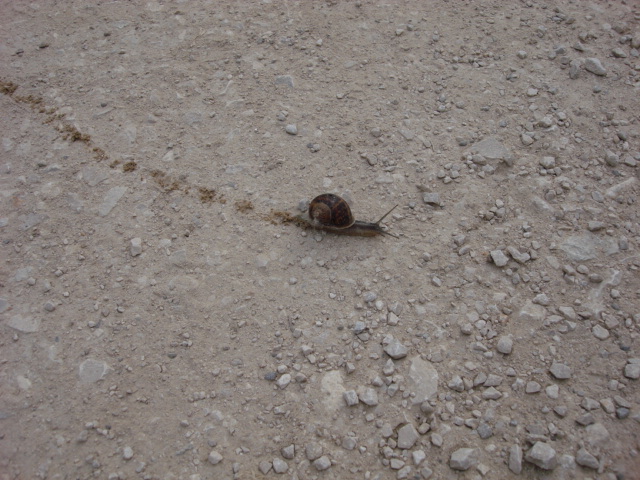
A day or two ago, I saw this amazing bug crossing the trail. The front of it was the size of the thorax of a large ant, but the back end was a good inch and a half long tapering, conical (like the twist of ice cream on a cone)in black and red. The bug just dragged this huge back end around with it wherever it went. There are also lots of snails - the kind that become escargot, and people actually come out and collect them!

White butterflies are everywhere, and some small orange ones and today I saw the most amazingly vivid, periwinkle blue one. No fireants, but they do have big gnats as of yesterday's walk.

There are wildflowers and cultivated flowers everywhere, some are familiar and some not. Hydrangeas, primrose, daisys, pink honeysuckle, purple thistle, something like tall, yellow buttercups and lots of orange and red poppies, and now just today, pink poppies. Then there are little white star shaped flowers, and lots of purple, pink, and blue flowers and yellow scrubby bushes. There are flowers everywhere!

Olive and almond trees are in groves lining the hills. And here in Navarra, lots of fields of vineyards, out of which they produce white and red wine (which is pretty good!)

The weather has been cool and breezy, which has been great for walking. It is hard to resist taking a picture of every beautiful vista, and our pictures don´t really do them justice anyway. One of these days, I will be at a computer where I can share them with you!

Companions

I´m having trouble keeping up with these entries because of lack of computer access. Even though I´m schlepping my netbook, I have yet to find wifi anywhere but Pamplona and, as at this alburgue, which has only one computer with free internet, access and time are very limited!

So, here goes a brief update...

We left Larasoana over the little narrow bridge infamous several centuries ago for the bandits that would attack pilgrims as they entered or exited the village. The creek that runs under it is famous for its trout and salmon these days. We were none too sad to say good bye to the place. It is still our yardstick (that is, absolute zero, on the scale) for measuring the quality of our accommodations.

From Larasoana, the road headed through Trinidad de Arre (the picture is the old bridge leading into it) to Pamplona (the city gate in the old fortified defenses) , to Cizur Menor (Little Cizur), a little town a few km on the other side (flags - including the Knights Templar - inside the 12th c. Order of Malta church in Cizur). For the record, there is also a Cizur Mayor (Big Cizur).

The walk to Pamplona was pretty enjoyable. I had my pack sherpa´d so I just had a light bag (maybe 6 or 7 lbs) to carry the necessities of the day and that in itself made the journey easier. The sun was out in a bright blue sky. A lot of the path was dirt and rocky, but not too strenuous. Parts of it were flagstoned. Some of it paralleled old Roman roads, where we could still see the ruins.

But what really makes the way enjoyable each day are the traveling companions we meet. I have shared most days with different people. Part of yesterday, before I met up in Zubiri with Michael (Denmark) and Christian (Sicily), was with Emilio from Milan. He and I had a great conversation. Then, when he found out that I was an Episcopal priest, he just really had a difficult time absorbing that information and processing it! So interestingly, he soon dropped behind! But, as often happens, we keep running into the same people over and over, so he is very friendly and waves and wishes "Buen Camino!"

On this day, I journey with a man whose name I never learn, but who is from Holland. He is about 15 years older than I am. And we enjoy a lively conversation about all sorts of things as we traverse a wide range of trails. He had owned his own cafe and then a restaurant for a number of years, and then had been employed by a bank, I think. (It´s really a great thing that so many people speak English!). Then, he had worked for three years helping people who had had brain injuries. At that time, he was 65 and he decided it was time for him. So he retired on a pension.

Walking the Camino was something he had planned to do for quite a number of years he said. He told me he planned to try to do the whole thing. (Lots of people do it in segments over a number of years, picking up where they leave off. Lots of people also do it multiple times, either choosing different routes, different modes of travel or just doing the whole thing over again. You can go 'a pie', on foot; 'a bici or bicicleta', on bicycle; or 'a caballo', on horseback.) At some point he asked me what I did. I told him I was a priest. I got the usual reaction, much like Emilio´s the day before, raised eyebrows, big eyes, skepticism. We talked about it. One of the things I said was "I marry people and I bury them," somewhat humorously. Well, that touched something in him, because a moment or two later, he turned around, really whirled around, and looked at me very seriously and said, "Are your REALLY a priest?" And I said, "Yes, I really am." And that opened the way for him to tell me the real reason that he was walking the Camino, something he had never told anyone, something that, on behalf of someone else, had been weighing him down for years. We talked about it and as a result, he is now in a different place, and not just geograpically. And to be honest, so am I, because what he told me touched me very deeply. I had tears in my eyes when he was telling me. It was a sacramental time. When we parted ways in the center city of Pamplona a while later, he was practically skipping, not able to wait to get to Santiago, years lighter in weight. If for nothing else perhaps, that is why I was to do this Camino at this time. And I never even learned this particular companion´s name...

This gentleman and I had walked fast, even for me, so I knew that I would have a wait for Mary and Stella to catch up. I didn't expect them to be that far behind and I thought perhaps we could have a Sunday meal together somewhere in the city. I decided if I waited by the city gate, they couldn't possibly miss me. So I sat down and waited. And I waited. And I waited. Pilgrims came and went. I couldn't believe they could possibly have been so far behind me. Three hours later, they finally came trudging up cobbled hill towards the city gate, having had a nice morning break somewhere, a stroll through Trinidad de Arre with someone showing them the way through town and not really interested in a meal! Oh well. At least I had had a good rest.

We stopped in a bar with loud music open to the street to use the facilities. Little did we realize that it was a Basque separatist stronghold! As we were leaving we got into a conversation with one of the young men there and he explained their cause. Spain has a law whereby prisoners must be put in prisons in the same region where their families are so they can have visits and some sort of outside contact. But for Basque terrorists or those who are labeled such when arrested, they are immediately imprisoned on the far side of the country, and if and when their family members make the journey on visiting day, they are told, "Sorry, visiting hours aren't today." So this young man said they are just asking that the prisoners be repatriated, in accordance with Spain's own law, to their own province, in this case Iruna, or Basque. Once we learned the flags and symbols of the separatist movement, it was easy to spot them everywhere, and for quite a distance from Basque, even in Madrid, later. And now I have a bumpersticker to prove I met a Basque separatist! After this, we got on the road again and headed on to Cizur Menor.

Monday, May 31, 2010

Neverending


(May 29th) We woke up so beautifully in Roncesvalles and began our walk through flat farm fields in beautiful blue skies. We walked about 3 or 4 kilometers before we got to the next village which the guidebook recommended as having a fine panaderia (bakery). We arrived about 10 minutes before it opened, but we decided it was well worth waiting, so we did. And it was! And we started something, because as soon as we ordered, the place filled up. Suddenly, there were walking sticks and backpacks everywhere! Tee con leche (tea with milk). It´s what I have every morning at home, but it tastes so good in another language!

So fortified, we started off. Little did we know that it was going to be such a long, long day. When I was in grade school, my family took a vacation to New England and we tried to get to Mystic Seaport. Everytime we saw a sign for it, it was further away than the last time. That became kind of an icon for my family. This was a Mystic Seaport kind of day. And in fact, coming out of one hilly town, I followed the sign towards Larasoanna, our destination for that night. It told me so many kilometers. It took me up a very steep and rocky, but quite beautiful, path with wildflowers everywhere, and a gorgeous view as I climbed near the top of this ridge. Then the path wound through woods at the top, past another memorial, this one for a Japanese pilgrim who died along the way, and finally - finally! - I came out at another sign for Larasoanna, which, just like Mystic Seaport, was now more kilometers away than when I had started up the trail! I felt like I had to have taken the wrong path (even though it was a very beautiful one through the flowers and the woods, and I thoroughly enjoyed it), but at the end of the day, when I checked with everyone else, they had all done the same thing!

I stopped in one little town for a break and watched a little boy, playing at being grown up with his dad. He moved wood with his play wheelbarrow, taking it all very seriously. He's very cute and oblivious to all the people who walk by.

We were still in the mountains of the Pyrenees, although coming out of them, which means going down hill, which means very hard on the knees. Some of the descent was exceedingly steep. There are lots of metaphors about the Camino in relationship to life and one of them is that there is lots of variations in the surface. Some parts are smooth and others are rutted and rocky. Others are simply dirt, while others are fancy. We have seen quite a variety. Parts of the walk that day were on flagstone paths, others were through wooded sections, still others through pastures. The descent into Zubiri was very steep, rocky and rutted and long. It was necessary to be very careful. Life, of course, has different sections, each of which has different textures, some of which are more difficult than others. One of the many other metaphors is that of sharing the journey - sometimes we walk alone, sometimes we walk with others, sometimes we change partners, sometimes we walk with many people and sometimes, we encounter people again. All of that has also already happened and happened that day.

I walk faster than Mary and Stella, even when I am not walking fast by my normal pace, so I was ahead of them by a ways by the time I reached Zubiri. It seemed to be a good time to wait on them and give them time to catch up. I wanted to make sure they saw the sign to Larasoanna. And also, there was reportedly no opportunity to get food in Larasoanna and the next day was Sunday and nothing would be open until we got to Pamplona, so we might want to think about getting something at the little tienda, or market, in Zubiri.

There was a lovely shaded spot, right where the trail to Larasoanna veered off - unfortunately, it was not down by the crystal clear little river where I so badly wanted to dip my feet! But I waited for a while. Which gave me a chance to meet and talk with Michael from Denmark. Mary and Stella didn´t show in the next 45 minutes, so Michael and I went to the market, got a few things, rounded up his friend, Christian, from Sicily (I just love the internationality of all this!) and the three of us headed onward. And onward. And onward. Did I say onward?

In Spain, you get more for your money with the average kilometer. Don´t believe the signs. They´re approximate, I´m sure. There are special signs just for the camino and you get used to looking for them everywhere. Yellow arrows will never be the same for me again. They are everywhere, though sometimes you really do have to have your eyes about you to see them. They are, or can be, on the pavement, on the side of buildings, on little posts out of the groud, on the back of street signs, on light poles. Sometimes they are just yellow arrows, sometimes they are a logo-ized version of a scallop shell, the symbol of St. James and the camino. (See my "Camino" page for why the Scallop shell is associated with St. James.)

We should have been getting pretty close when we saw one that said Larasoanna was just 1.9 km away. Okay, that´s less than one and a half miles. We can do that. We walked and we walked and we walked, through fields and woods, by hedges. Finally, as we were passing a horse farm, I asked the guy in my pigeon-Spanish and he said something like ´yea, yea´and waved us on down the road, so we continued on further for a ways. Then we passed a backpacker coming our way and asked him and he said in broken English, "Oh, you´re really close, just a few more steps!" Well, about a quarter mile later, we finally were there. Mystic Seaport, all over again.

Quirky little place, Larasoanna. There's a little bridge crossing over to it from the pilgrimage trail. The guidebooks say that bandits used to lay in wait for travelers entering and leaving the village to rob them. Fortunately, there don't seem to be any on this day. There are lots of trout swimming in the river, though. The village is small, and skinny, squished between a highway (it's easy to forget that you're close to civilization when you're on the Camino) and the trail, but not very long. Perhaps a hundred or more folks live here. Again, they grow beautiful roses, but there is not much else to recommend it. The lady who checks me into the refugio is not terribly welcoming and doesn't appreciate my attempts to speak Spanish. She tells me, "You are in Spain; speak Spanish!" Sounds rather like some not so kind Americans I have heard. So Larasoanna is not high on my list of must-see villages. No-frills refugio, with an awful ladies' room. At least four men around me snoring all night. Mary and Stella were late enough checking in that Stella gets one of the bunks downstairs just outside the bathroom doors, so she is awakened all night long as the lights are turned on and the doors are slammed. We eat at the only little restaurant bar in town. Ed and Terry from Rochester NY were there, along with Peter from Germany and Laurence, a woman from Quebec, and others we met along the way. Not very good pasta, pretty good beef stew and some runny rice pudding. My first Spanish beer - Keler. Not bad. Moving on in the morning which will be okay.