St. James

St. James
St. James above the special anniversary door of the cathedral in Santiago

Wednesday, June 2, 2010

Solitude

Cizur Menor to Puente La Reina (Queensbridge for Anglophiles)- Monday, May 31st. A really good day of walking. There were still hills to be climbed and descended - and I´ve given up really trusting the elevation charts that they first gave us when we started back in St. Jean Pied du Port. They seem to give false impressions about how difficult or easy days or going to be. Or perhaps our abilities and expectations have changed?

For once, I am not with a walking companion during a good bit of the day, although there is almost always someone within 100 or 200 yards ahead and/or behind me on the trail. I was just talking with someone else today (June 2) about this and she agreed, I have never once felt afraid or even alone. It´s sort of like the Communion of Saints, for those of you reading this who are familiar with that phrase. I see the footprints in the dust or mud of those who have gone before and know that mine are being left for those behind me. God knew my pack was too heavy and I somehow managed to leave my copy of the guidebook behind early in the trip (probably in the Atlanta airport), so I look at Stella or Mary´s most mornings and then just go from there. But the trail is so well marked that I have not had to worry.

Anyway, it is a gorgeous day on the trail. Out of Cizur, there is a nice flagstone trail for a while, across relatively flat fields with low bumps of hills. Loads of wildflowers line the walkway, and occasionally pilgrims "a bici" pass me by, some at higher rates of speed than others. The red poppies are prolific here. At one point, I glance up to my right at a hillside where there appear to be two ruins of buildings and one looks for all the world like a stone jack-o-lantern looking back at me. Up on the hill to the left is a village but we end up bypassing it.

Then we begin to climb the side of a ridge leading up to yet another peak, Alto de Perdon, though now, relative to the mountain, none seem so bad. The path has changed to gravel. All along the ridge are wind turbines.
The guide book describes their sound as an eerie whoosh. Personally, it just sounds like wind to me. They are lovely, like ballet dancers. There are very dark clouds closing in and I am sure I am going to get caught in a storm on this side of the ridge, but the rain stays off in the distance. Finally reaching the crest, there is a wonderful, two-dimensional sculpture, kind of life-size, of weathered sheets of inch thick metal. It is a Canterbury Tale like parade of pilgrims, modern style, done to commemorate the Camino. There's even a dog! As I arrive at the top, there are lots of people there and I think that they are all pilgrims who have have stopped to celebrate. Then I realize that a bunch of them are simply on a bus tour! There's a refreshment stand taking advantage of the trade, so I get a granola bar and pause, enjoying the vistas in all directions, then head on.

I descend another steep and rocky descent into fields and I feel like dancing in the fields, ala Maria in the early scenes of Sound of Music, which I do, kinda, but restrain myself a bit. It is lovely! There are a number of small towns, including one that has a special octagonally shaped church, but I decide not to detour to it. There is a church with a stained glass windown with a scallop shell in it, though. Then, I reach Obanos, which goes out of its way to welcome pilgrims. It begins with a welcoming walkway, complete with inlayed bricks and six inch, bronzed or copper scallop shells in relief. They form a path along the Camino as it wends its way through the town. If you´re not looking at shells, you´re not on the right path. In the middle of town is a church with an interesting crucifix and (I think) an outdoors baptismal font. Then you go under an arch (marked with the scallop shell symbol) and out of the town. As you exit, still on this nice path, there is a sign from the Ministers of the town to all pilgrims wishing us "Ultreya!" which means "Onward!" and something else which I couldn´t quite translate. Not all the towns are quite this welcoming. Many of the communities along the Camino exist solely for the purpose of the Camino, sort of like railroad towns in the States. This town knows it and is grateful.

I reach Puente la Reina by a little past noon which is wonderful - I have plenty of time to get settled into the alburgue, cleaned up, wash clothes and explore the town! Puente la Reina, another town which exists solely for the Pilgrimage, is an important point on the Camino Francese. Three main routes through France all merged to come through Roncevalles and on to Pamplona, but a fourth, the Aragonese route, now joins the other three here in Puente la Reina.

The alburgue isn't bad - I claim my bunk in one of the rooms, take a shower, wash out my clothes and go hang them up on the very colorful tendedero (clothesline) outside. There are already a number of pilgrims relaxing on the sunny lawn. I walk down the Calle Mayor (Main Street) and see the sights. I marvel at the gardening people can do in their walled backyard gardens. The sidewalk is higher in some places, so I can see over! Their gardens are so neat and well tended, and the soil looks so rich. One building has red geraniums across the length of every balcony from top to bottom! Not much is open at this time of day except a few cafes.

Centuries ago, the town was renowned for bandits which plagued the pilgrims who crossed the Arga river on a ferry at this point. So a queen (they aren´t quite sure which one of two) gave the town this beautiful stone arch bridge so the pilgrims could cross safely. We will use it as we leave tomorrow. After exploring the bridge, I find a pharmacy and get a support for one knee that is bothering me after all the rocky, steep descents. Then I look for a place for lunch. There is a nice little cafe with tables and chairs out by a tree-lined esplanade, so I settle in there. As I'm enjoying a salad with the local white asparagus on top and a glass of the local wine, thinking about how amazing it is that, here I am, sitting in this neat little town in Spain, all by myself, someone calls my name! It´s Paul, a young man from Chicago, who will be going to Roman Catholic seminary this fall, and three young women with him, Therese, Taryn and Dana who are doing the Camino. They wave and call "Buen Camino!" as they walk by and I return the cheer. The German and French men in a group at the table behind me, who have been discussing the running of the bulls in Pamplona in English, now switch to a discussion of the Camino and why people do it. Eavesdropping can be interesting! (And it isn´t as if I had a choice ;)) Then, right after that, I get a phone call from Mary´s other niece, telling me about the arrival plans of Lexi and Josh who have finally managed to catch a flight the night before, albeit to Barcelona. It feels very surreal to at one moment be thousands of miles from home by myself in Spain and the next moment have my name called by someone walking by and then get a telephone call. This is the 21st century!

At last, I end my wonderful little lunch and make my way back to the alburgue. Stella and Mary have arrived. In the evening, we wander back towards the downtown, stopping into the church next to the alburgue. There are storks nesting in its dome. The crucifix there was carved and given to the church by a German pilgrim. We stop in another church in the center of town, and there is a statue of St. James inside which is covered in gold leaf. More stores are back open now after the afternoon siesta, including some little touristy ones, catering to pilgrims. We come back to the little cafe where I had lunch and have a nice dinner. Ed and Terry from Rochester and Laurence from Montreal end up joining us, as does a woman from Florida. A delightful evening in a delightful little town!

Creation

In the last segment of the blog, I wrote mostly about human companions, but I am so aware of the flora and the fauna with which I share this journey as well. I begin each day with what Mary, my spiritual director, mentioned to me, "Oh Lord, don't let me miss anything this day!" And while I am sure there really is quite a bit that I am not able to take in, because there is just sensory overload with new things all around me at each moment and around each bend, I do my best to be aware of the changes in trees and flowers and shrubs, the terrain, the animals, the way the light hits everything at different times of the day, and how everything sounds and smells. It is truly a feast for the senses and such a gift to be walking in Creation for this length of time.

On the way out of Larasoana, there was this wonderful stretch where I was walking by myself through these beautiful, cool woods on a nice, soft, dirt path. Suddenly, there appeared before me a horse, all by himself. He seemed a little startled to see me, and a little shy, but not too afraid. This one, as opposed to the ones on the mountain, was full sized, built more like a draft or farm horse, but free to roam through the woods. He looked at me and then gave me no more thought as he walked up into a clearing. A moment or two later, another horse appeared in the fringe of trees along the path. Though it stayed in the trees, it was within perhaps four feet of me as I passed. Okay, here´s a secret - I talk to animals as I pass them: Buen perro! (Good dog!) Hola, Caballo! (Hello, horse!) Gracias, parajo! (Thank you, bird!) Buenas Dias, Gatito! (Good day, kitten!) Buenas Tardes, Vaca! (Good afternoon, cow!) Call me Dr. Doolittle if you will, but I suspect deeply that they know and they do answer, whether I can really understand or not. So I talked to these horses which kept appearing in this sort of magical woods all along the trail. Unfortunately, I didn't get any pictures of them, because they kept catching me by surprise. If they were white and each had a horn coming out of their foreheads it couldn´t have felt more amazing and grace-filled. There are definitely times when I feel a little like Dorothy walking towards Oz on this trip. It is so awesome to me, in the best sense of that overused word, to be in the wild in the presence of another part of God´s kingdom, such as a horse roaming free, and to feel accepted by that creature. I loved being in that stretch of woods. I paused by a river (the same one that had the trout, I think) and just enjoyed watching it rush through the rocks and trees, the play of nature, one part with another. The music of the rushing water was wonderful. Later, I paused on a bridge into a village over the same little river for my mid-morning break to eat an orange, and again enjoyed the rush of water over rocks, looked for the fish, listened to the breeze in the trees that lined the banks...ah, nature!

Today (June 2) as I'm writing this, we saw our first snake on the path, probably something akin to a garter snake, about four foot long and what looked to be non-poisonous. It ran away from us (Carmel and her son, Alex, from Halifax, Canada and myself) on our way to Los Arcos. I also saw one of the many falcons today, but haven´t had a chance to check the guide book to see which kind yet. There are lots of birds of prey here (kites, kestrals, falcons, hawks) and I can't really tell most of them apart, but I love watching how they ride the winds and swoop over the fields, searching for their meals. Two nights ago, in Puenta La Reina, there was a stork (they're everywhere here!) nesting in the top of the dome of the church next to our alburgue. (The picture is actually the church tower in Belorado because the nests show up better.) There were some fledglings poking their little white heads up out the large, messy twig nest. Cuckoos have called in many places. I guess it's the influence of Monty Python, but I can't help imagining this big joke, where men in tights are always running around within a couple hundred yards of me in the woods or somewhere just out of sight, pushing around a huge cuckoo clock! I have a hard time believing they are real birds, I guess, but I understand they are not very nice as they take over other birds' nests and kick out their young to raise their own. That's not near as cute as they look on clocks!

Yesterday, as I crossed over a river that is drying up (that according to the 14th century guidebook you aren´t supposed to let your horse drink from because the water is bad and it will kill your horse, and there are bandits waiting to skin your horse) there are frogs that sound just like sheep bleating. And not only do frogs sound like sheep, sheep sound like cows, because sheep wear cow bells here. Only I guess they are sheep bells.

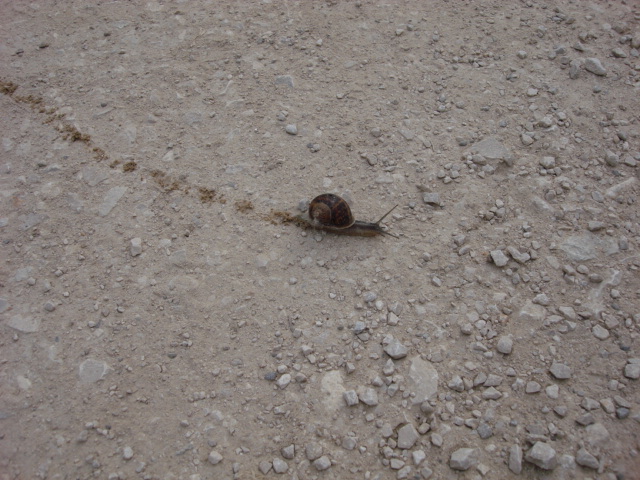
A day or two ago, I saw this amazing bug crossing the trail. The front of it was the size of the thorax of a large ant, but the back end was a good inch and a half long tapering, conical (like the twist of ice cream on a cone)in black and red. The bug just dragged this huge back end around with it wherever it went. There are also lots of snails - the kind that become escargot, and people actually come out and collect them!

White butterflies are everywhere, and some small orange ones and today I saw the most amazingly vivid, periwinkle blue one. No fireants, but they do have big gnats as of yesterday's walk.

There are wildflowers and cultivated flowers everywhere, some are familiar and some not. Hydrangeas, primrose, daisys, pink honeysuckle, purple thistle, something like tall, yellow buttercups and lots of orange and red poppies, and now just today, pink poppies. Then there are little white star shaped flowers, and lots of purple, pink, and blue flowers and yellow scrubby bushes. There are flowers everywhere!

Olive and almond trees are in groves lining the hills. And here in Navarra, lots of fields of vineyards, out of which they produce white and red wine (which is pretty good!)

The weather has been cool and breezy, which has been great for walking. It is hard to resist taking a picture of every beautiful vista, and our pictures don´t really do them justice anyway. One of these days, I will be at a computer where I can share them with you!

Companions

I´m having trouble keeping up with these entries because of lack of computer access. Even though I´m schlepping my netbook, I have yet to find wifi anywhere but Pamplona and, as at this alburgue, which has only one computer with free internet, access and time are very limited!

So, here goes a brief update...

We left Larasoana over the little narrow bridge infamous several centuries ago for the bandits that would attack pilgrims as they entered or exited the village. The creek that runs under it is famous for its trout and salmon these days. We were none too sad to say good bye to the place. It is still our yardstick (that is, absolute zero, on the scale) for measuring the quality of our accommodations.

From Larasoana, the road headed through Trinidad de Arre (the picture is the old bridge leading into it) to Pamplona (the city gate in the old fortified defenses) , to Cizur Menor (Little Cizur), a little town a few km on the other side (flags - including the Knights Templar - inside the 12th c. Order of Malta church in Cizur). For the record, there is also a Cizur Mayor (Big Cizur).

The walk to Pamplona was pretty enjoyable. I had my pack sherpa´d so I just had a light bag (maybe 6 or 7 lbs) to carry the necessities of the day and that in itself made the journey easier. The sun was out in a bright blue sky. A lot of the path was dirt and rocky, but not too strenuous. Parts of it were flagstoned. Some of it paralleled old Roman roads, where we could still see the ruins.

But what really makes the way enjoyable each day are the traveling companions we meet. I have shared most days with different people. Part of yesterday, before I met up in Zubiri with Michael (Denmark) and Christian (Sicily), was with Emilio from Milan. He and I had a great conversation. Then, when he found out that I was an Episcopal priest, he just really had a difficult time absorbing that information and processing it! So interestingly, he soon dropped behind! But, as often happens, we keep running into the same people over and over, so he is very friendly and waves and wishes "Buen Camino!"

On this day, I journey with a man whose name I never learn, but who is from Holland. He is about 15 years older than I am. And we enjoy a lively conversation about all sorts of things as we traverse a wide range of trails. He had owned his own cafe and then a restaurant for a number of years, and then had been employed by a bank, I think. (It´s really a great thing that so many people speak English!). Then, he had worked for three years helping people who had had brain injuries. At that time, he was 65 and he decided it was time for him. So he retired on a pension.

Walking the Camino was something he had planned to do for quite a number of years he said. He told me he planned to try to do the whole thing. (Lots of people do it in segments over a number of years, picking up where they leave off. Lots of people also do it multiple times, either choosing different routes, different modes of travel or just doing the whole thing over again. You can go 'a pie', on foot; 'a bici or bicicleta', on bicycle; or 'a caballo', on horseback.) At some point he asked me what I did. I told him I was a priest. I got the usual reaction, much like Emilio´s the day before, raised eyebrows, big eyes, skepticism. We talked about it. One of the things I said was "I marry people and I bury them," somewhat humorously. Well, that touched something in him, because a moment or two later, he turned around, really whirled around, and looked at me very seriously and said, "Are your REALLY a priest?" And I said, "Yes, I really am." And that opened the way for him to tell me the real reason that he was walking the Camino, something he had never told anyone, something that, on behalf of someone else, had been weighing him down for years. We talked about it and as a result, he is now in a different place, and not just geograpically. And to be honest, so am I, because what he told me touched me very deeply. I had tears in my eyes when he was telling me. It was a sacramental time. When we parted ways in the center city of Pamplona a while later, he was practically skipping, not able to wait to get to Santiago, years lighter in weight. If for nothing else perhaps, that is why I was to do this Camino at this time. And I never even learned this particular companion´s name...

This gentleman and I had walked fast, even for me, so I knew that I would have a wait for Mary and Stella to catch up. I didn't expect them to be that far behind and I thought perhaps we could have a Sunday meal together somewhere in the city. I decided if I waited by the city gate, they couldn't possibly miss me. So I sat down and waited. And I waited. And I waited. Pilgrims came and went. I couldn't believe they could possibly have been so far behind me. Three hours later, they finally came trudging up cobbled hill towards the city gate, having had a nice morning break somewhere, a stroll through Trinidad de Arre with someone showing them the way through town and not really interested in a meal! Oh well. At least I had had a good rest.

We stopped in a bar with loud music open to the street to use the facilities. Little did we realize that it was a Basque separatist stronghold! As we were leaving we got into a conversation with one of the young men there and he explained their cause. Spain has a law whereby prisoners must be put in prisons in the same region where their families are so they can have visits and some sort of outside contact. But for Basque terrorists or those who are labeled such when arrested, they are immediately imprisoned on the far side of the country, and if and when their family members make the journey on visiting day, they are told, "Sorry, visiting hours aren't today." So this young man said they are just asking that the prisoners be repatriated, in accordance with Spain's own law, to their own province, in this case Iruna, or Basque. Once we learned the flags and symbols of the separatist movement, it was easy to spot them everywhere, and for quite a distance from Basque, even in Madrid, later. And now I have a bumpersticker to prove I met a Basque separatist! After this, we got on the road again and headed on to Cizur Menor.

Monday, May 31, 2010

Neverending


(May 29th) We woke up so beautifully in Roncesvalles and began our walk through flat farm fields in beautiful blue skies. We walked about 3 or 4 kilometers before we got to the next village which the guidebook recommended as having a fine panaderia (bakery). We arrived about 10 minutes before it opened, but we decided it was well worth waiting, so we did. And it was! And we started something, because as soon as we ordered, the place filled up. Suddenly, there were walking sticks and backpacks everywhere! Tee con leche (tea with milk). It´s what I have every morning at home, but it tastes so good in another language!

So fortified, we started off. Little did we know that it was going to be such a long, long day. When I was in grade school, my family took a vacation to New England and we tried to get to Mystic Seaport. Everytime we saw a sign for it, it was further away than the last time. That became kind of an icon for my family. This was a Mystic Seaport kind of day. And in fact, coming out of one hilly town, I followed the sign towards Larasoanna, our destination for that night. It told me so many kilometers. It took me up a very steep and rocky, but quite beautiful, path with wildflowers everywhere, and a gorgeous view as I climbed near the top of this ridge. Then the path wound through woods at the top, past another memorial, this one for a Japanese pilgrim who died along the way, and finally - finally! - I came out at another sign for Larasoanna, which, just like Mystic Seaport, was now more kilometers away than when I had started up the trail! I felt like I had to have taken the wrong path (even though it was a very beautiful one through the flowers and the woods, and I thoroughly enjoyed it), but at the end of the day, when I checked with everyone else, they had all done the same thing!

I stopped in one little town for a break and watched a little boy, playing at being grown up with his dad. He moved wood with his play wheelbarrow, taking it all very seriously. He's very cute and oblivious to all the people who walk by.

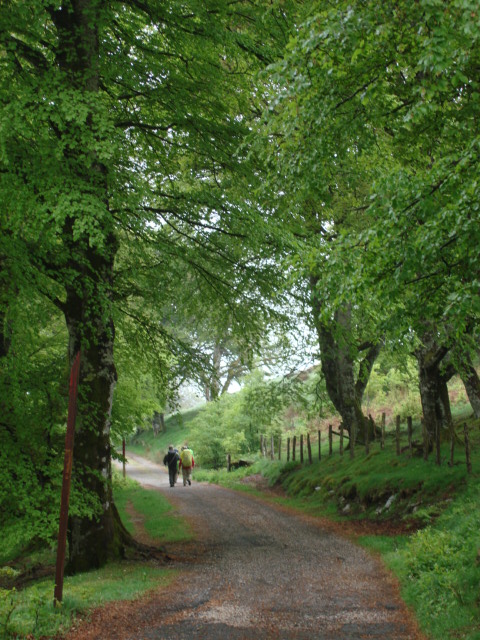
We were still in the mountains of the Pyrenees, although coming out of them, which means going down hill, which means very hard on the knees. Some of the descent was exceedingly steep. There are lots of metaphors about the Camino in relationship to life and one of them is that there is lots of variations in the surface. Some parts are smooth and others are rutted and rocky. Others are simply dirt, while others are fancy. We have seen quite a variety. Parts of the walk that day were on flagstone paths, others were through wooded sections, still others through pastures. The descent into Zubiri was very steep, rocky and rutted and long. It was necessary to be very careful. Life, of course, has different sections, each of which has different textures, some of which are more difficult than others. One of the many other metaphors is that of sharing the journey - sometimes we walk alone, sometimes we walk with others, sometimes we change partners, sometimes we walk with many people and sometimes, we encounter people again. All of that has also already happened and happened that day.

I walk faster than Mary and Stella, even when I am not walking fast by my normal pace, so I was ahead of them by a ways by the time I reached Zubiri. It seemed to be a good time to wait on them and give them time to catch up. I wanted to make sure they saw the sign to Larasoanna. And also, there was reportedly no opportunity to get food in Larasoanna and the next day was Sunday and nothing would be open until we got to Pamplona, so we might want to think about getting something at the little tienda, or market, in Zubiri.

There was a lovely shaded spot, right where the trail to Larasoanna veered off - unfortunately, it was not down by the crystal clear little river where I so badly wanted to dip my feet! But I waited for a while. Which gave me a chance to meet and talk with Michael from Denmark. Mary and Stella didn´t show in the next 45 minutes, so Michael and I went to the market, got a few things, rounded up his friend, Christian, from Sicily (I just love the internationality of all this!) and the three of us headed onward. And onward. And onward. Did I say onward?

In Spain, you get more for your money with the average kilometer. Don´t believe the signs. They´re approximate, I´m sure. There are special signs just for the camino and you get used to looking for them everywhere. Yellow arrows will never be the same for me again. They are everywhere, though sometimes you really do have to have your eyes about you to see them. They are, or can be, on the pavement, on the side of buildings, on little posts out of the groud, on the back of street signs, on light poles. Sometimes they are just yellow arrows, sometimes they are a logo-ized version of a scallop shell, the symbol of St. James and the camino. (See my "Camino" page for why the Scallop shell is associated with St. James.)

We should have been getting pretty close when we saw one that said Larasoanna was just 1.9 km away. Okay, that´s less than one and a half miles. We can do that. We walked and we walked and we walked, through fields and woods, by hedges. Finally, as we were passing a horse farm, I asked the guy in my pigeon-Spanish and he said something like ´yea, yea´and waved us on down the road, so we continued on further for a ways. Then we passed a backpacker coming our way and asked him and he said in broken English, "Oh, you´re really close, just a few more steps!" Well, about a quarter mile later, we finally were there. Mystic Seaport, all over again.

Quirky little place, Larasoanna. There's a little bridge crossing over to it from the pilgrimage trail. The guidebooks say that bandits used to lay in wait for travelers entering and leaving the village to rob them. Fortunately, there don't seem to be any on this day. There are lots of trout swimming in the river, though. The village is small, and skinny, squished between a highway (it's easy to forget that you're close to civilization when you're on the Camino) and the trail, but not very long. Perhaps a hundred or more folks live here. Again, they grow beautiful roses, but there is not much else to recommend it. The lady who checks me into the refugio is not terribly welcoming and doesn't appreciate my attempts to speak Spanish. She tells me, "You are in Spain; speak Spanish!" Sounds rather like some not so kind Americans I have heard. So Larasoanna is not high on my list of must-see villages. No-frills refugio, with an awful ladies' room. At least four men around me snoring all night. Mary and Stella were late enough checking in that Stella gets one of the bunks downstairs just outside the bathroom doors, so she is awakened all night long as the lights are turned on and the doors are slammed. We eat at the only little restaurant bar in town. Ed and Terry from Rochester NY were there, along with Peter from Germany and Laurence, a woman from Quebec, and others we met along the way. Not very good pasta, pretty good beef stew and some runny rice pudding. My first Spanish beer - Keler. Not bad. Moving on in the morning which will be okay.

Friday, May 28, 2010

Whew

We left our cozy alburgue or gite d'rural at Hunnto after a breakfast of hearty crusty bread, butter and jam and either tea or coffee.
We knew we were facing a tough day and the sky was looking rather overcast. As we checked out of the hostel, we noted a card for transport services for backpacks. Stella and I were more than a little interested. Note that we are wearing shorts, mostly because of the weather we had experienced the day before. We will learn that one can not judge the weather by the day before!
It turned out that the sherpa services are Caroline, the same person who had been our shuttle driver the day before. We tried to contact her, but with no luck, so we were just starting out up the mountain, when suddenly, who should drive up, but Caroline, on her way up to the other alburgue about 1.5 km further up the mountain. We flagged her down. She highly advised against her taking our bags due to inclement weather expected on the mountain, but for Stella and I, that was all the more reason TO do it! So I quickly grabbed all that I thought I would need for the day, including my windbreaker, but not my poncho, which was too far down, and stuffed it into the small canvas bag (my carry-on for the airline) and slung that over my shoulders. Caroline was not happy, but she took our bags and agreed to drop them off at Roncevalles, on the other side of the mountain. Mary, meanwhile, looked on, with no qualms about shouldering her bag. I didn't know how much my bag weighed, but I knew it was over 20 lbs. Mary's was somewhere around 15 and Stella's was probably about 17 (to get lighter and lighter as she left things behind along the Camino!).

Talking about challenging, today was probably the most physically challenging of the trip, though others will be challenging for duration and heat. Today we did about 19km, mostly upwards and some very steep, between Hunnto and Roncevalles, so we are now back in Spain. While yesterday, I was really glad to see the gite at Hunnto, words cannot describe the joy at seeing the monastery today about 2 pm at Roncevalles after starting out at 730 this morning at Hunnto!

About 1.5 km after Hunnto was another alburgue, Orisson.
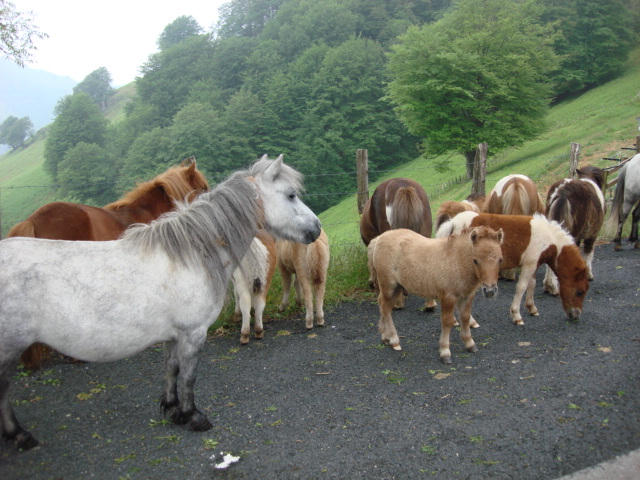
We stopped there for a brief break and to get sandwiches to take with us, because it was the last inhabited place between there and Roncevalles. Wild horses and ponies gather around this refugio, mostly looking for food handouts. There are two kinds of the horses/ponies - wild and farmers'. You can tell them apart because some have bridles on. We saw them a number of times before we got too far up the mountain.
Just knowing that there are 17 km of non-inhabited land ahead of us is enough to give one pause for thought! All of the land between is prime grazing land for herds of cattle, sheep and horses and that has first priority over human habitation. Surprisingly, there were a number of vehicles, though. It was difficult, but lovely views for a little while. Then, as we got higher and higher, the fog set in. And then mist, which turned into light rain, and a little wind. I so wished tht I had pulled out my poncho, but I still would have been wet to the bone in my shorts and boots. It was rather miserable for quite a while. Visibility was down to about 50 feet or so, so there were absolutely no views to be had. The only choice was to keep going. About two-thirds of the way up the mountain, the path takes a turn off a more defined trail for a more rugged, rustic path. At this point, there is a well-known arrow marker so that (hopefully) pilgrims won't miss it. It is sort of a point to say, "Yea, we just might make it yet!" So, since some other hikers were with us, we took the photo op!


You have to learn to walk at your own pace on the Camino, and while Stella was often fastest at the uphills, I had, in general, the fastest pace. I would have been just as uncomfortable trying to slow down and stay with Mary who was next closest behind me somewhere in the fog, or Stella, further back, as either of them would have been trying to keep up with me. I have always been a fast walker, and, in my running days, a relatively fast runner with a long stride for my leg length. So as a result, I lost them in the fog and mist and had only myself and unseen herds of sheep for companionship for much of the time...

[Did I leave you hanging? Sorry, haven´t had internet access for the last couple days and now I am limited by the only euro I have in my pocket. Still haven´t found wifi to be able to download pictures from my computer, just internet access in the refugios/alburgues where we are staying that look a lot like old computer game terminals. ]

Anyway, the day on the mountain was arduous, but pretty neat in some ways. Like being challenged beyond your limits and meeting the challenge. For the most part, I was in a world by myself, except when I happened along some other pilgrim or occasionally someone passed me - there are a number of folks who walk faster! The fog closed to within 30 or less feet of visibility at times, as we climbed higher, and the hood of my jacket kept me from seeing much of the woods around me. There were the occasional sounds of birds - real cuckoos before we got up too far (they´re not just for clocks anymore!) The climb up was rather brutal. I waited somewhere for Mary and Stella to catch up and we crossed into Spain near the top of the peak just as the landscaped changed to a very weird, gray, slaggy, slate-like, other-worldly place. It was almost like something out of a horror or sci-fi movie. There were call boxes on posts every so many feet with numbers on the posts. These were so if pilgrims got stranded in really bad weather, they could call for help. Somewhere, we passed our first marker to a pilgrim who had died on the mountain because he couldn't be rescued in time. A sobering thought.

On the way down the mountain, there were places where there were seasons upon seasons of leaves piled upon each other and it was rather fun walking on them. It was odd being in a world by myself (Stella and Mary were somewhere behind me again), not the sound of another human invention (plane,train or automobile) or being. Interesting things take on colors in this world of drizzly grays and browns, like this lizard, who was a sharp black and yellow. It was rather mystical, but my field of vision was so limited by the hood of my jacket and looking downward, out of the rain, that I felt a little cheated, walking through a world that I wanted to see more of, but couldn´t quite. Everything was so still, yet so alive, so quiet, yet so in the moment, if that makes any sense. Every drip of rain was important. I was colder and wetter than anytime I could remember since I had been a child playing in the snow.

I walked on and on, alone, but not alone, aware that I was being watched over, not just by God, but by the woods, by creatures that had their eyes on me. Eventually, I worked my way down out of the mist and clouds to a long series of hair pin curves. I finally linked up with other pilgrims - Livia and Alesandra from Milano, a couple from Germany and some others. With them, I started following some of the short cuts. The last part of the journey, about 20 minutes perhaps, was through a beautiful wooded stretch. We came to a place where there was a monument, and then a small church, and then finally, we rounded a turn and there, at last, was a view of the gray tiles of the monastery. We all cheered spontaneously.

I arrived in Roncevalles about an hour before Stella and Mary, so I got checked in, found Stella's and my backbacks (glad to spend the 8 euros, but Caroline had been right about the weather!), settled into a bunk in the huge alburgue and began to explore a bit. The alburgue was in a large building (sleeping 100 pilgrims in bunk beds all in one room!) with thick stone walls. The main monastery is constructing a large wing to match the original building to expand their capacity. The doors of the alburgue closed at 10, and when late arriving pilgrims knocked on the door, they were not let in (the place was full anyway), rules are rules! There was a small gift shop in the monastery, and I rewarded myself for the day's journey with an artisan milk chocolate bar with almonds! I don't think the monks made it, but I'd like to think I was helping them out a little bit!

There was a service in the abbey that evening which was beautiful. It was a communion service to welcome and bless all of the pilgrims, and even though it was a Roman Catholic service, all of us participated. I don't think God sees the same lines as we do. The priest, knowing that there were people there of all different persuasions said something to the effect, that one day, we would all eat at the same table, and I understood him to invite everyone, so we went. As part of the service, it was read out how many pilgrims had registered from what country that day, and whether they were on foot (a pie), on a bike (a bici), or on horseback (a caballo). A lot of pilgrims start in Roncevalles, rather than do the mountain which we had just crossed. It felt like quite an accomplishment already, but it also felt wonderful to be continuing on with such a special blessing.

We had dinner at one of the two little restaurants, La Sabina. I had leek soup, wonderful roasted, stuffed red peppers in a sauce, and (oddly, we thought) little, store-bought yogurts for dessert. I didn't sleep too well, since I'm not used to listening to the sounds of 100 other people, and especially the Swedish woman in the next bunk who snored loudly ALL night! But, in the morning, we were awakened in the most delightful way at 6 am. First, there were light chimes. Then, the big rings of lights (not bright lights, just imagine rings like in old castles, suspended from the ceiling) were turned on. Then, the volunteer host circled among the bunk beds singing a beautiful Alleluia in his lovely bass voice. Afterwards, as people were doing the usual shuffling of packs and all, he turned on a CD that included music and natural sounds of bird calls and wind in trees. It was lovely beginning to a morning.

Challenged

Caroline drives us across a small river and announces that we have arrived in France. There are houses and businesses on both sides of the river; those to the south or west are in Spain, and the ones we are passing now are in France. Prices in stores are better on the Spain side, Caroline explains, but real estate prices are better in France. What's a person to do?

A few kilometers further and we arrive in the beautiful and historic little town of St. Jean Pied-du-Port. Here, the river runs right through the middle of the town, or else this is a feeder river to the other.
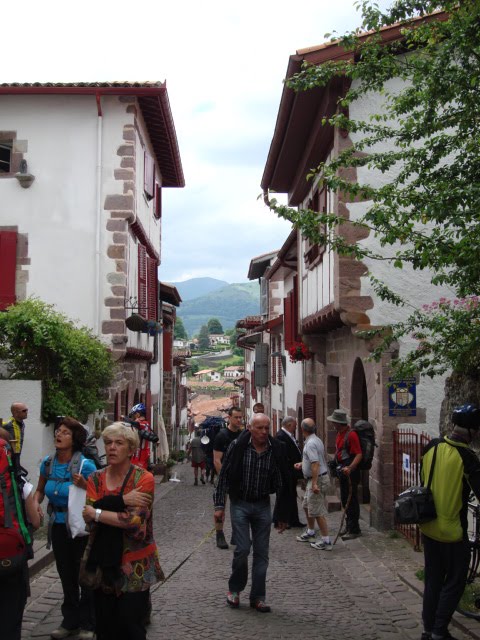
The cold, beautiful river rushes over rocks as it tumbles down on its way out of the Pyrenees and then is tamed by walls through the little city. It is a walled city from perhaps the 16th century (Laura will probably check me on this, I can´t remember the details at the moment.) Many of the medieval pilgrims were French and they started at a tower near Notre Dame in Paris, according to James Michener in his book Iberia, and the French Route, the Camino Francese, went through St. Jean. There are scallop shell desisgns (the symbol of the route) embedded in the cobbled streets, as well as a fountain outside of the church. They are the first of many that we will see on this trip.


I would love to return to this little town and explore it more. Even though it is in France, it is still part of the Basque region. As we drove by fields filled with sheep, Caroline explained that the particular breed with black faces and legs is unique to Basque. From the milk of these sheep is made a special cheese, Ossau Iraty (I think I have that right). I haven´t had a chance to taste it yet. Lunch before we started was real French quiche with a light, wonderul salad in a little back garden of a cafe.

We registered in the official pilgrim's office and got our credentials stamped again (they were stamped at the alburgue in Pamplona, and then we were also able to get them stamped at the Cathedral and at the City Hall - we're starting to look a little, just a little, official!). They also give us some helpful information about alburgues and other useful things. We choose our official St. James scallop shell (they're much larger than in the US - about 4 - 5 " across) and tie them onto our backpacks, where they will stay for the duration of our journey. And then, with the well-wishes of the office volunteers, we are off!

We go down the hill on SJPP's cobblestone street and set foot out of the city gate and taking our first official step on our pilgrimage. Our first choice awaits us 100 yards up when we have to choose between the over the mountain route or the route that goes by the road we just traveled. Where we are staying this night is 6 km up the over the mountain route. We chose this based on Caroline´s recommendation. The road she just brought us on was the windiest road I have perhaps ever been on with more hairpin turns and no shoulder. It also would have had no views to speak of, other than over the guardrail into gullies. On the other hand, the over-the-mountain route was leaving us open to a much more physically challenging route, possibly through difficult weather, but with the promise of exquisitely stunning views of the Pyrenees. That´s why we had chosen the latter. Last week here was very warm, but the week before they had had snow in the upper elevations! And this is late May we are beginning!

Well, we began the over-the-mountain route. Very shortly after we started climbing, I saw a fragment of blue and white tile. I collect blue and white china bits from when I'm out walking - it seems I find them in the strangest places. I picked this piece up and I almost put it in my pocket to save as a souvenir. But then I put it back down in the dirt. I decided that part of this journey was about learning to let go, about learning to do with less (it might not seem like much, but across all those miles, it would get to be a lot - especially if I kept adding to the collection!). So I kept going...

I can honestly say that those first 6 km kicked my butt. By the end, I was going telephone pole to telephone pole and taking a brief rest at each one before I could go on! At the risk of sounding overly pious (because I most certainly was not), I was taking three deep breaths at each stop, one in the name of each member of the Trinity. Not for any reason other than it gave me more time to pause and contemplate how in the world I was going to go on. It felt like we were climbing virtually straight upward. Compared to where all three of us live, it was vertical! Mary seemed to be doing fine (on a relative basis), while Stella was coming up slowly behind me. I couldn't imagine, if the rest of the trip was going to be anything like this, how I was ever going to accomplish it. But we kept turning around and saying, ¨Oh...look!¨ because the vistas were so stunning.


If I was happy to get to Madrid Airport, I was really happy to get to Hunnto, the ´gite rural´ (French way to say "B&B out in the country") where we stayed. It was superb. We ended up with a private room. Mary had a double bed downstairs and Stella and I had twins up in the loft. Our sliding glass doors opened to a common balcony with a to-die-for view of the Pyrenees, with sheep and cows baaing and mooing just outside.

Dinner was a wonderful peasant fare of flavorful, rustic vegetable soup, crusty bread, and chicken in a buttery sauce with lentils, all flavored superbly, followed by a local cheese with homemade blueberry preserves, and then a small apple tart. And local wines. Yummm. The dining room had the same view of the mountains and valleys, along with a courtyard with a rose arbor. They grow the most beautiful, lush roses over here, deep red, orange and yellow in particular. We had people at the table from Korea, France, Germany, Italy, Switzerland and America (that we know of, there may have been more). It was a full day in the richest sense of the word. God is gracious.